 Comparison
Estate Sale vs Private Sale: Which Returns More for Belongings
Last Updated: November 7, 2026
Quick Summary
For a full household, an estate sale versus private sale usually favors the estate sale, because one company handles pricing, sales, and cleanup in a few days. A private sale can net more on a handful of high-value pieces, but only if the family has the time and product knowledge to price and reach buyers. Many families split the difference by privately selling the top items and running the rest through an estate sale.
- Compare estate sale and private sale results on net proceeds, not gross sales.
- Ask estate sale companies for their commission rate and fee schedule in writing.
- Watch for last-day markdowns and unsold-item cleanout charges that reduce net proceeds.
- Privately sell high-value, identifiable pieces such as jewelry, art, and antiques.
- Decide in advance what happens to unsold items: donation, consignment, auction, or disposal.
Table of Contents
- What Separates an Estate Sale from a Private Sale
- How Estate Sales Work for Sellers
- How Private Sales Work and What They Demand
- Estate Sale Company Commission and Net Proceeds Compared
- Estate Sale Pros and Cons
- Selling Inherited Items: Choosing the Right Route Item by Item
- Choosing Your Route and Booking a Consultation with WTS Solutions
- Frequently Asked Questions
Deciding whether to sell a loved one's belongings through an estate sale versus private sale is one of the first hard choices after a death. The answer depends on how many items you have, how valuable they are, and how much time and energy your family can give. WTS Solutions works with families in Vancouver, Washington through this exact decision, and the framework below is how we help them think it through.
What Separates an Estate Sale from a Private Sale
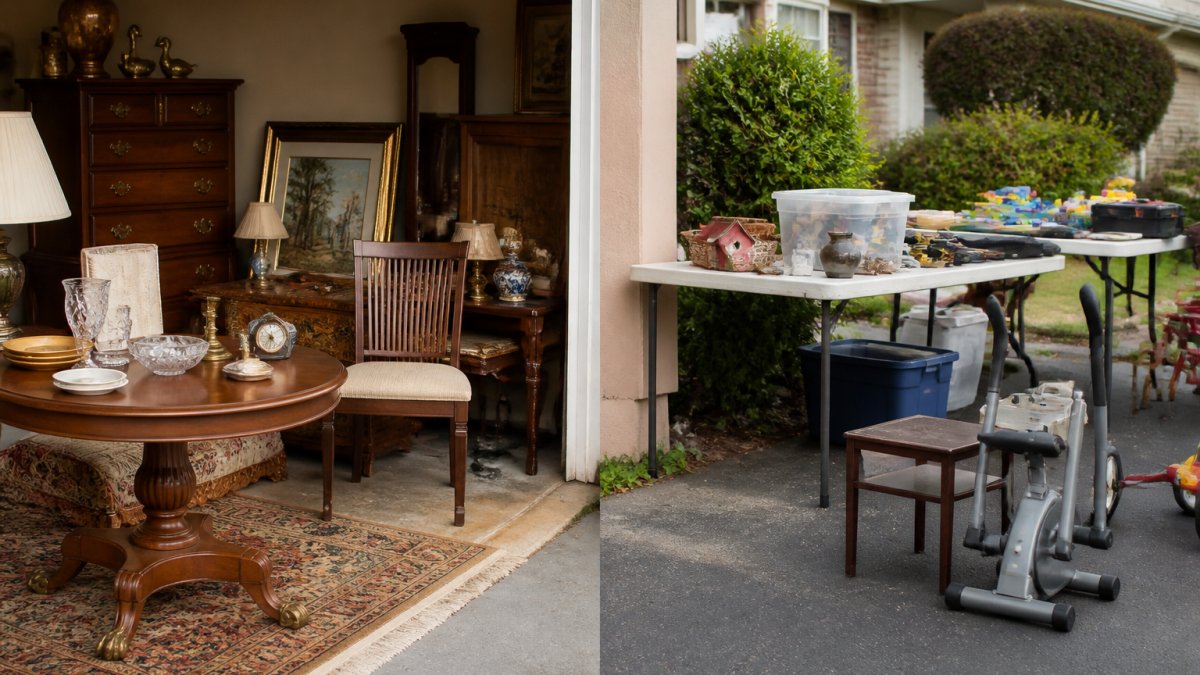
An estate sale is a public sale held in the home, usually run by a company that prices, displays, and sells the household contents together. Compare estate sales and garage sales in detail to see how the two formats differ. A private sale is when the family sells specific items directly to buyers, one at a time or in small groups. The first moves many belongings at once. The second is slower and more hands-on.
The core difference is who does the work. A private sale can make sense for a handful of special items when the seller has time, product knowledge, and access to buyers. For a full house, though, a private sale rarely scales.
How Estate Sales Work for Sellers
An estate sale company typically handles the sale itself. Sellers do not need to find buyers or negotiate with strangers.
Expect buyers to pay secondhand prices and to negotiate. Plan for that from the start, so the sale does not feel like a disappointment when offers come in lower than family members hoped.
How Private Sales Work and What They Demand
A private sale puts the family in charge of every step. You research values, photograph items, write listings, answer messages, arrange viewings, and manage payment and pickup. That is a real commitment, especially while grieving.
The return can be higher for a small number of special pieces, but only if you can price them accurately and reach the right buyers. A common mistake is listing a valuable item at a guessed price and waiting months for a response. Without product knowledge, a private sale can cost more in time than it returns in money.
Estate Sale Company Commission and Net Proceeds Compared
Gross sales tell you what buyers paid. Net proceeds tell you what your family keeps. The gap between the two is where most estate-sale disappointment lives, and it is the number you should compare against a private sale before you choose a route.
Estate-sale companies generally charge a commission on what sells. Ask each company for its rate in writing. Some quote a sliding scale that steps down as gross sales rise, and some add a minimum or a flat setup fee.
Build a simple net-proceeds worksheet before you sign anything. Learn how to value household items so the gross figures you plug in are realistic. Start with an honest gross estimate, then subtract each line:
- Commission at the quoted rate, applied to the gross you expect.
- Discounting. Some companies mark items down on the last day to clear the house. If half your inventory sells at a discount, your effective commission rate climbs because the fee is charged on the reduced price.
- Unsold-item costs. Ask whether the company charges to remove, donate, or dispose of what does not sell. A per-item haul-away fee or a cleanout charge can erase a meaningful share of a modest sale.
- Preparation and staging. Some companies charge for cleaning, staging, or security, or require the family to cover those costs separately.
- Repairs and touch-ups. If the home is being listed for sale, post-sale cleaning and minor repairs come out of the same pool of money.
A common pattern is a family that hears "40% commission" and budgets accordingly, then discovers the last-day markdowns and the cleanout fee push the real cost of the sale well past that figure. That is especially important when unsold furniture and debris still need hauling, so include the cost of clearing the property—whether through Duty First Dumpster Company or another option—before judging which sale leaves more in the estate.
Private sales carry their own cost stack, and it is easy to underestimate. Listing platforms and payment processors take a cut, shipping and packing eat into high-value fragile items, and your own hours have a value even if no invoice arrives. A private sale can leave you with a larger share of each sale, which is why a small number of high-value pieces can net more privately even after fees.
Compare the two on net, not gross. If an estate sale grosses a large number but the commission, markdowns, and cleanout take a third or more, the private route may win on a handful of special items while losing badly on the rest of the household.
Estate Sale Pros and Cons
Pros of an estate sale:

- Handles a full household in a few days
- Removes the burden of finding and dealing with individual buyers
- Works well for general household goods and mixed contents
Cons of an estate sale:
- Commission reduces what the family keeps
- Buyers expect bargains, so many items sell below retail
- Valuable pieces can be undervalued if they are not separated for specialist sale
Selling Inherited Items: Choosing the Right Route Item by Item
Most estates are not all-or-nothing. Many families find it helpful to sort belongings into routes before anyone prices a single item, then match each route to the item type, the seller's time, and the likely outcome. Use the comparison below as a working decision tool rather than a set of rules.
Match the item to the route.
- High-value, identifiable pieces, fine jewelry, watches, art, antiques, collectibles, quality instruments, designer handbags. These reward a private sale or a specialist dealer because the buyer pool is narrow and informed. A general estate-sale crowd will not pay specialist prices for them.
- General household goods, furniture, kitchenware, tools, linens, everyday electronics, garage contents. These move fastest through an estate sale, where volume and foot traffic do the work.
- Bulky or low-value items, worn furniture, mattresses, older appliances, partial sets. These often cost more to sell than they return and belong in the donation or disposal stream from the start.
- Sentimental items, photographs, letters, family pieces. Keep these out of any sale until the family agrees, and document the agreement so a later dispute does not reopen the estate.
Compare the routes on the dimensions that actually decide it.
| Dimension | Estate sale | Private sale |
|---|---|---|
| Time to cash | Days to a few weeks | Weeks to months per item |
| Seller effort | Low after handoff | High, photos, listings, messages, showings, pickup |
| Buyer pool | Local foot traffic, often bargain-driven | Targeted, national or niche for the right item |
| Likely outcome | Whole house cleared, prices moderate | Higher price on the right piece, no sale on the wrong one |
| Risk | Commission and markdowns reduce net | No-shows, scams, chargebacks, damaged goods |
Use a decision tree keyed to time, volume, and expertise.
- Is the house on a deadline, a closing date, a lease end, a move-out? If yes, an estate sale or a hybrid plan is usually the only route that clears the home in time.
- Is the household large, a full house of mixed contents? Volume favors an estate sale; private selling a whole house rarely scales.
- Do you have product knowledge and time for the top items? If yes, privately sell the handful of pieces that justify the effort and route the rest to the estate sale.
- Are you unsure what is valuable? Get an appraisal on the pieces you suspect before you commit to any route. An appraisal fee is small against the cost of sending a valuable piece through a general sale.
Plan for what does not sell. Every route leaves a remainder, and the remainder has a cost. Decide in advance whether unsold items go to donation (with a receipt for the family's records), consignment, a local auction, recycling, or disposal. Ask the estate-sale company in writing what it does with leftovers and what it charges.
Private-sale logistics and risks deserve their own checklist. Photograph items in good light, write specific listings with measurements and condition notes, price from sold comps rather than asking prices, and state pickup terms up front.
Keep the paper trail. Whoever has authority to sell estate property should confirm it before the first item leaves the house. Beneficiaries should agree in writing on which items are sold privately and how proceeds are split. Keep records of every sale, fee, and donation receipt; they matter for the estate accounting and may matter at tax time.
A workable default for most families is the hybrid: privately sell the few pieces that reward it, run the household through an estate sale, and have a donation and disposal plan ready for the remainder. That sequence captures the upside on the items that have it without asking the family to run a months-long private sale on a full house.
Choosing Your Route and Booking a Consultation with WTS Solutions
If you are weighing these options for a parent's home or a relative's move, you do not have to make the decision by yourself. You don't have to face this alone when a professional team can walk through the sorting, the valuations, and the logistics with you. For a clear view of how estate sales compare with consignment before you commit, read Estate Sale vs Consignment: Pros, Cons & Comparison.
WTS Solutions works with professionals who can help families with estate sales, move-outs, and move management. We aim to help families connect with the professionals they need, so you can focus on what matters most. Contact us to talk through your situation and schedule a consultation. Pricing depends on the size of the home, the number of items, and the services you need. Contact WTS Solutions for current prices or a quote.
Frequently Asked Questions
What is the difference between an estate sale and a private sale?
An estate sale is a public, on-site sale run by a company that prices, displays and sells most of a home's contents together, usually over a weekend. A private sale is handled by the seller or a family member who sells particular items to individual buyers, often through listings, referrals or consignment. Estate sales suit clearing a full house quickly. Private sales suit a small number of valuable items when the seller has time, product knowledge and access to buyers.
Do estate sale companies charge a commission?
Yes. Estate sale companies generally take a commission on what sells, and the rate varies by company. Some companies also add fees for advertising, clean-out or staging, so ask for a written breakdown before signing. Compare the total cost against the net proceeds you expect to keep, not just the headline percentage. WTS Solutions can explain how partner estate sale companies structure their fees; contact us for current details.
Can you make more money selling belongings privately?
Sometimes, but only for a small number of special items. A private sale may produce a higher price for a few valuable pieces when the seller has time, product knowledge and buyer access. For a full household, the time, marketing and risk of sales that fall through often outweigh the price advantage. Estate sales also move general household goods that private buyers rarely want. Pricing depends on the items involved, so compare realistic offers before deciding.
How do estate sales work for sellers?
The company typically walks through the home, separates valuable pieces for specialist sales and prices the remaining household goods. It then advertises the sale, runs it on-site over a few days, and handles buyers and checkout. Sellers usually receive a payout after the sale, minus the company's commission and any fees. Unsold items are handled under the contract, often donated or removed. Ask how unsold goods are treated before you sign.