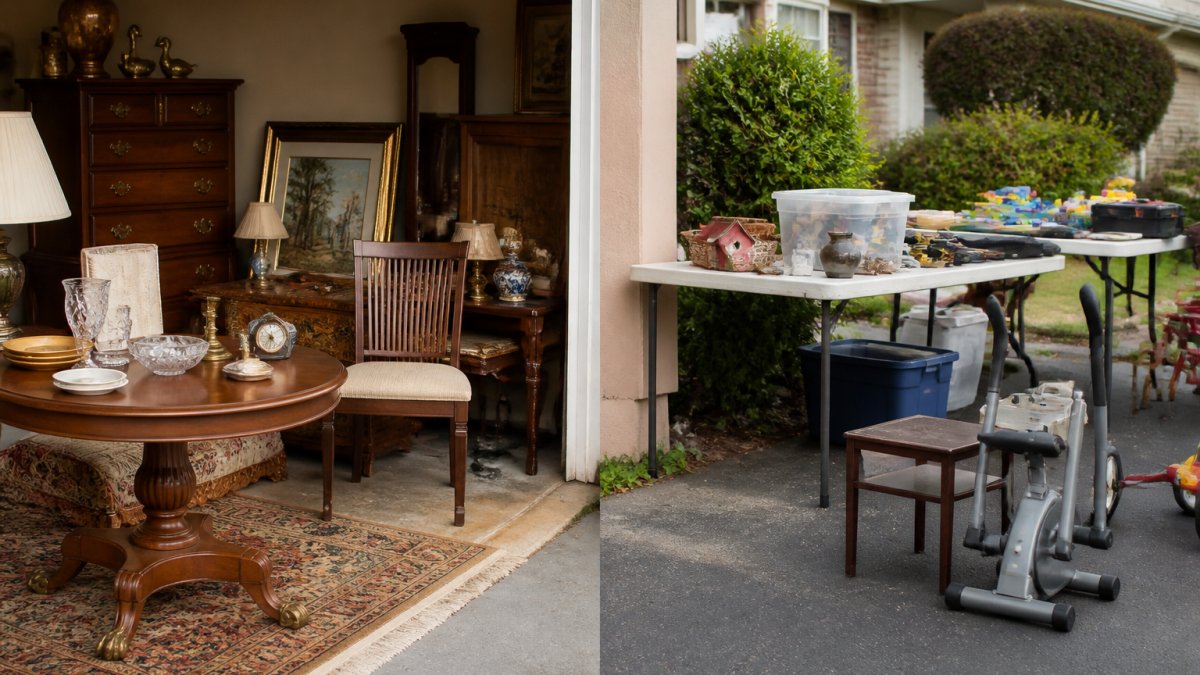
 comparison
Estate Sale vs Garage Sale: Key Differences
Last Updated: October 23, 2026
Quick Summary
Estate sale vs garage sale differs fundamentally in scope and management: estate sales are professionally managed events covering entire homes with hundreds to thousands of items, while garage sales are self-managed events selling dozens to hundreds of everyday items from a property. Estate sales attract dealers and collectors through professional pricing and marketing, whereas garage sales target local neighbors seeking quick deals.
- Estate sales charge 30% to 50% commission on gross sales, while garage sales have no professional fees
- Estate sales take 2-4 weeks prep plus 1-3 day events; garage sales require 1-2 weeks prep and typically run one day
- Estate sales price items individually based on fair market value; garage sale pricing typically ranges from 20-30% of original retail value
- Estate sales work best for valuable collections, antiques, and furniture; garage sales suit everyday household items needing quick liquidation
Table of Contents
- Estate Sale vs Garage Sale: Quick Comparison
- What Defines an Estate Sale
- What Defines a Garage Sale
- Estate Sale Company Fees and Commission Structure
- How to Price Items for a Garage Sale
- Estate Sale Preparation Checklist
- Choosing Between an Estate Sale and Garage Sale
- Conclusion
- Frequently Asked Questions
Estate Sale vs Garage Sale: Quick Comparison
An estate sale vs garage sale comparison reveals two fundamentally different approaches to liquidating household belongings. The core distinction lies in scope, professional involvement, and the value of items being sold. Understanding these differences helps families make the right choice when managing a loved one's property or clearing out a home during a transition.

Estate sales typically involve a professional company managing the entire process. They cover a larger portion of a home's contents, often spanning multiple rooms or an entire household. Garage sales, by contrast, are self-managed events where homeowners sell items from their garage, driveway, or yard.
At WTS Solutions, we help families navigate this decision by providing expert guidance on which approach maximizes the value of their belongings while minimizing stress during an already difficult transition. Let's break down the key differences so you can determine which option suits your situation.
| Factor | Estate Sale | Garage Sale |
|---|---|---|
| Scope | Entire home or multiple rooms | Garage, driveway, or yard |
| Item Volume | Hundreds to thousands | Dozens to hundreds |
| Professional Help | Yes, managed by company | Self-managed |
| Pricing Method | Individual pricing by professionals | Homeowner sets prices |
| Timeline | 2-4 weeks prep, 1-3 day event | 1-2 weeks prep, 1 day event |
| Typical Inventory | Furniture, antiques, collectibles, art | Everyday household items |
| Buyer Type | Dealers, collectors, retail shoppers | Neighborhood locals |
| Best For | Large collections, valuable items | Quick liquidation of common items |
What Defines an Estate Sale
An estate sale is a professional liquidation event where a specialized company manages the pricing, marketing, and sale of a deceased person's belongings or the contents of a home being cleared during a major life transition.
Estate sales are designed for larger collections of household belongings, often spanning an entire home. The professional company prices items individually based on fair market value, current demand, and condition.
A defining feature of estate sales is their comprehensive nature. Rather than sorting items into categories, the sale company displays everything as it was found in the home. A bedroom might contain furniture, artwork, clothing, jewelry, and personal collections all sold together.
The professional management extends to marketing as well. Sale companies advertise through their own networks, online platforms, and local media, drawing buyers from a wider geographic area than a typical garage sale. This broader reach often translates to better pricing and faster liquidation of inventory.
What Defines a Garage Sale
A garage sale (also called a yard sale or tag sale) is a self-managed event where homeowners sell unwanted items directly from their property. The homeowner handles pricing, setup, advertising, and customer interaction.
Garage sales appeal to budget-conscious shoppers in the local community. Buyers expect to negotiate prices and often seek deals on items they can use immediately.
The preparation timeline for a garage sale is shorter than an estate sale. Most homeowners spend one to two weeks gathering items, pricing them, and arranging the display. Advertising typically involves yard signs, online classified listings, and word-of-mouth.
Garage sales work well for clearing out unwanted items quickly without the investment of professional services. However, they require significant personal effort to organize, price, and manage customer interactions. Unsold items often end up being donated or discarded, which can feel wasteful if those items have genuine value.
Estate Sale Company Fees and Commission Structure
Professional estate sale companies typically charge a commission based on the total sale proceeds, rather than a flat fee. This commission structure aligns the company's incentive with yours: they earn more when items sell for higher prices.
Beyond commission, some companies charge additional fees for services like photography, advertising, or specialized handling of valuable items like art or antiques. A few may charge a flat setup fee regardless of sale results.
The commission structure means that while you're paying a significant percentage of proceeds to the sale company, their expertise can be valuable. Items that might sell for $5 at a garage sale could sell for $25 or more at an estate sale, which can help offset the commission cost.
For families managing an estate, understanding these costs is crucial. Hiring professional help for estate sales: A complete guide provides detailed information on what professional services entail and how to evaluate whether the investment makes sense for your situation.
How to Price Items for a Garage Sale
Pricing items correctly for a garage sale balances two competing goals: attracting buyers with reasonable prices while maximizing your return on items that have genuine value. Start by researching comparable items on online marketplaces, resale platforms, and local classified listings to understand what similar items are selling for in your area.
A practical approach is to price items at 20-30% of their original retail value. A kitchen appliance that cost $80 new might price at $15-25. Furniture typically sells for 10-25% of original cost, depending on condition and style.
Condition matters significantly. Items in excellent condition with all original parts command higher prices. Worn, stained, or damaged items should be priced lower to move quickly. Be honest about condition, buyers appreciate transparency and are more likely to return if they feel they received fair value.
How to value items for estate sale: A step-by-step guide offers comprehensive guidance on valuation methods that apply to both estate sales and garage sales. The principles of fair pricing remain consistent across both sale types, though the market context differs.
Consider grouping similar items and offering bundle deals. Three coffee mugs priced individually at $1 each might move faster as a set for $2. This strategy reduces the number of individual price negotiations and speeds up the checkout process.
Estate Sale Preparation Checklist
Preparing for an estate sale requires systematic organization and documentation. The professional sale company will guide you through many steps, but understanding the process helps you prepare your home and belongings effectively.
Initial Assessment and Documentation:
- Photograph valuable items and collections for insurance and inventory purposes
- Create a list of items you want to keep or remove before the sale
- Identify any items with sentimental value that should be set aside
- Note any items requiring special handling (art, antiques, fragile collectibles)
Home Preparation:
- Clean and organize rooms to showcase items effectively
- Ensure adequate lighting throughout the home
- Arrange furniture to allow buyer traffic flow
- Remove personal items like family photos and documents
- Repair or address obvious damage that affects item value
Coordination with Sale Company:
- Provide detailed information about high-value items
- Discuss any items requiring specialized knowledge or appraisal
- Clarify the commission structure and fee arrangement
- Confirm the timeline for setup, sale dates, and item removal
- Understand what happens to unsold items
Logistics and Access:
- Arrange parking for buyers and the sale company's staff
- Plan for security during the sale period
- Ensure the home is accessible during setup and sale days
- Consider weather protection if items will be displayed outdoors
- Arrange for utilities to remain on during the sale
The preparation phase typically lasts two to four weeks, depending on the home's size and the complexity of the collection. Professional estate sale companies handle most of the detailed work, but your cooperation and organization accelerate the process and improve results.
Choosing Between an Estate Sale and Garage Sale
Choose an estate sale when you have hundreds of items spanning multiple rooms, significant quantities of furniture, or collections with potential value (antiques, art, collectibles, vintage items).
Choose a garage sale when you have a modest quantity of everyday household items, you want to complete the sale quickly with minimal preparation, and you're comfortable managing pricing and customer interactions yourself.
Estate sale vs consignment: Pros, cons & comparison explores how these options compare with other liquidation methods.
Consider the emotional and logistical burden as well. Managing an estate sale requires coordination with professionals but removes the day-to-day stress from your shoulders.
You don't have to face this alone explains how professional services can help simplify this decision and manage the entire process, allowing you to focus on what matters most during a difficult transition.
Conclusion
The choice between an estate sale and a garage sale depends on your specific situation: the volume and value of items, your available time, and how much professional support you need. Estate sales suit larger collections and valuable belongings, while garage sales work for quick liquidation of everyday items.
Managing either type of sale during a major life transition adds stress to an already difficult time. At WTS Solutions, we bridge the gap between grieving families and qualified professionals, providing expert guidance on asset liquidation, probate, and move management. Our partnerships with estate sale companies and comprehensive move management services ensure your belongings are handled with care.
According to research on estate liquidation practices, families increasingly turn to professional services when managing large-scale asset sales. For families navigating probate and estate settlement, the American Bar Association's guide to estate administration offers comprehensive legal context for understanding how asset liquidation fits into the broader estate process.
Frequently Asked Questions
What is the main difference between an estate sale and a garage sale?
An estate sale is a comprehensive liquidation of a household's belongings, typically managed by professionals who price items based on fair market value and handle all advertising and sales logistics. A garage sale is a smaller, self-managed sale usually limited to items in a garage, driveway, or yard, with prices set by the homeowner. Estate sales cover decades of accumulated belongings and often include antiques, collectibles, and valuable items, while garage sales focus on everyday household goods and unwanted items.
How much do estate sale company fees typically cost?
Estate sale company fees vary based on the size of the sale, number of items, and local market conditions. Most companies charge a commission based on gross proceeds, though some may negotiate rates for larger estates. Additional costs may include advertising, setup, and cleanup. For accurate pricing for your specific situation, contact a local estate sale company directly or reach out to WTS Solutions for guidance on understanding fee structures and maximizing your net proceeds.
What items should I avoid putting in an estate sale?
Avoid items that are damaged, stained, or broken, as they typically don't sell and take up valuable display space. Exclude hazardous materials, recalled products, and items with missing parts or instructions. Perishable goods, opened cosmetics, and used undergarments should not be included. Items with sentimental value that you wish to keep should be removed before the sale. Consult with your estate sale company about any items you're uncertain about, they can advise on what will attract buyers and generate fair returns.
Is an estate sale worth it for a small or modest estate?
An estate sale can be worthwhile even for modest estates if you have a mix of valuable items, antiques, or collectibles. However, if your belongings are primarily everyday household goods with minimal resale value, a garage sale or donation may be more practical. Consider the time and effort required to self-manage a garage sale against the professional management and potentially higher returns of an estate sale. WTS Solutions can help you evaluate your specific situation and recommend the best approach for your family's needs.