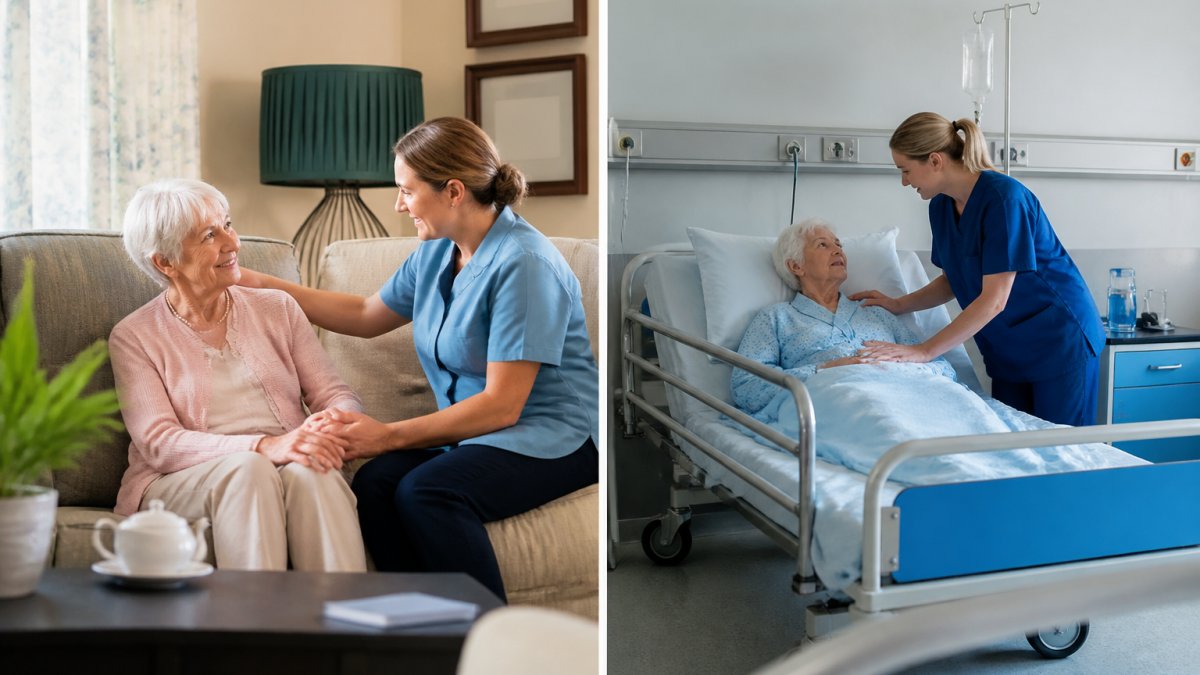
 comparison
Assisted Living vs Nursing Home Care Explained
Table of Contents
- What Assisted Living and Nursing Homes Provide
- Core Differences: Medical Care, Staffing, and Supervision
- Assisted Living vs Nursing Home Cost: What to Budget
- Assisted Living vs Skilled Nursing Facility: When Each Makes Sense
- When to Move from Assisted Living to Nursing Home
- Questions to Ask When Choosing Senior Care
- Managing the Transition: Professional Support for Your Family
- Frequently Asked Questions
Last Updated: October 6, 2026
What Assisted Living and Nursing Homes Provide
Understanding the differences in assisted living vs nursing home care shapes your loved one's daily life, independence, and access to medical support. Understanding what each provides is the first step toward the right choice.
Assisted living is residential care for seniors who need help with daily tasks but want to maintain independence. Residents live in private or semi-private apartments, manage their own schedules, and receive support only where needed, a bridge between living independently at home and requiring round-the-clock medical supervision.
Nursing homes (also called skilled nursing facilities) provide comprehensive medical care in a residential setting, with nursing staff on duty 24 hours a day.
Assisted Living: Daily Support with Independence
Assisted living communities help residents with activities of daily living, bathing, dressing, grooming, meal preparation, and medication reminders. Staff are available throughout the day and evening, but residents aren't under constant medical observation.
Life in assisted living revolves around the resident's preferences: sleeping in, attending an exercise class, lunch with friends, an afternoon in their own apartment, dinner with the community.

Nursing Homes: Round-the-Clock Medical Care
Nursing homes provide skilled nursing care around the clock. Licensed nurses and certified nursing assistants monitor health, administer medications, manage wounds, assist with mobility, and respond to emergencies. Residents have less control over daily schedules because care routines are built around medical needs.
A typical day includes scheduled meals, medication at set times, therapy sessions, bathing assistance, and monitored rest. Staff track vital signs and adjust care plans as conditions change. While many nursing homes offer activities, the primary focus is medical management rather than independent living.
Core Differences: Medical Care, Staffing, and Supervision
The distinction between assisted living and nursing home care comes down to three factors: medical supervision, support staff on site, and physical environment. These determine whether a setting can safely support someone's health needs.
Level of Medical Supervision and Nursing Staff
Assisted living facilities typically employ health aides and activity coordinators, with a nurse available during business hours or on call, no medical staff overnight in most communities. This works for seniors with stable conditions like arthritis, mild memory loss, or controlled diabetes who don't need constant monitoring.
Nursing homes employ licensed nurses (RNs and LPNs) 24/7, with doctors visiting regularly and medical equipment standard. This staffing is necessary for people recovering from surgery, managing complex medications, dealing with advanced dementia, or needing rehabilitation. If your loved one needs someone to notice immediately when their condition changes, round-the-clock nursing is essential.
Activities of Daily Living Support
Both settings help with activities of daily living (ADLs), bathing, dressing, grooming, toileting, and eating. The difference is in how much help is needed and how much structure surrounds it.
In assisted living, staff respond when residents ask or when caregivers identify a need. A resident might bathe independently most days but ask for help when arthritis flares, or dress themselves but need help with buttons.
In nursing homes, ADL support is more structured and comprehensive because residents typically have greater physical limitations. Staff may assist with all bathing and dressing, and meals are served at set times. This structure exists because residents often can't safely manage these tasks alone.
Living Environment and Privacy
Assisted living apartments give residents their own space. Most communities offer studio or one-bedroom units with private bathrooms, so residents can decorate with personal items, host family visits, and control who enters their space. Common areas exist for socializing, but participation is optional.
Nursing home rooms are typically semi-private (two beds) or private, depending on availability and cost. The environment is designed for medical care and safety, with medical equipment, call buttons, and monitoring systems. Privacy is more limited because staff need regular access to provide care.
Assisted Living vs Nursing Home Cost: What to Budget
Costs vary by location, facility quality, and services included, but the pattern is consistent: assisted living costs less than nursing home care.
Research indicates assisted living averages around $5,900 per month for a private apartment, while nursing home care for a semi-private room averages approximately $9,277 per month.
The cost difference reflects staffing and medical oversight: nursing homes employ more licensed professionals, operate 24-hour nursing coverage, and maintain medical equipment, while assisted living communities have fewer staff and less complex infrastructure.
Beyond monthly fees, consider what's included. Some assisted living communities charge extra for medication management, transportation, or memory care.
Assisted Living vs Skilled Nursing Facility: When Each Makes Sense
The right choice depends on your loved one's health status and the support they actually need. Many families struggle here, choosing a setting either more intensive (and expensive) than necessary or one that doesn't provide adequate medical support, forcing a difficult move later.
Chronic Conditions Managed in Assisted Living
Assisted living works well for chronic but stable conditions. Someone with arthritis, mild cognitive decline, controlled diabetes, or heart disease managed with medication can often thrive there. The key word is "stable", the condition isn't rapidly changing and doesn't require constant monitoring.
Examples include a widow with osteoarthritis who needs help with housekeeping and bathing but manages her own medications; someone with early-stage memory loss who benefits from reminders but still recognizes family; or a person recovering from a fall who needs physical therapy but is expected to regain most function. Assisted living provides the right support without unnecessary medical intensity.
Complex Medical Needs Requiring Skilled Nursing Care
Nursing home care is appropriate when health requires constant professional monitoring: advanced dementia with behavioral changes needing immediate response, recovery from major surgery requiring wound care and therapy, conditions needing frequent medication adjustments, or multiple coexisting serious illnesses.
Someone with Parkinson's disease experiencing falls, confusion, and swallowing difficulties needs nursing home care because these symptoms change rapidly and pose safety risks. A person with advanced cancer requiring pain management and end-of-life support needs 24-hour nursing.
The question to ask: Does your loved one's condition require a licensed nurse to be present immediately if something changes? If yes, nursing home care is necessary. If no, assisted living may be appropriate.
When to Move from Assisted Living to Nursing Home
Many families start with assisted living, hoping their loved one can stay indefinitely. Sometimes that works; often, declining health requires a transition to nursing home care.
Plan ahead rather than waiting for a crisis. If health is declining, schedule a care assessment with the doctor and discuss whether nursing home care might be needed within the next year.
Transitions between care settings are emotionally difficult for families and seniors alike. Working with professionals who specialize in move management can ease both the emotional and logistical burden during these changes.
Questions to Ask When Choosing Senior Care
This decision requires specific information about your loved one's needs and the facilities you're considering. Generic questions aren't enough, you need to know exactly what each setting offers and whether it matches your situation.
Assessing Care Needs and Health Status
Start with a clear picture of your loved one's health and functional abilities. Can they bathe themselves? Remember medications? Walk safely? Do they have cognitive decline affecting judgment or safety? Are there conditions requiring frequent monitoring?
Write down specific examples.
Ask the doctor directly: What level of care does my loved one need? Can assisted living safely support their health status, or do they need skilled nursing care? Will their condition likely change within a year or two? Medical clarity prevents choosing a setting that's inadequate or unnecessarily intensive.
Evaluating Staffing, Services, and Quality
When you visit facilities, ask about staffing ratios, how many residents does each staff member support? In assisted living, ratios vary widely. Ask about nursing availability: is a nurse on site during the day? Reachable after hours?
Ask what's included in the monthly fee and what costs extra, some facilities include meals and transportation, others charge separately. Ask about medication management: does staff administer medications, or does your loved one manage their own?
Check inspection records and quality measures, most states publish facility inspection reports and complaints online, and numerous violations are a red flag. Ask for references from current residents' families; speaking with people who actually use the facility provides insights marketing materials never will.
| Consideration | Assisted Living | Nursing Home |
|---|---|---|
| Medical supervision | Daytime staff, on-call nursing | 24-hour licensed nurses |
| Best for | Stable chronic conditions, independent seniors needing support | Complex medical needs, intensive care |
| ADL support | Partial assistance, resident-directed | Comprehensive assistance, staff-directed |
| Cost range | ~$5,900/month average | ~$9,277/month average (semi-private) |
| Living space | Private or semi-private apartment | Semi-private or private room |
| Staffing | Health aides, activity coordinators | RNs, LPNs, nursing assistants |
| Typical stay | Long-term residential | Short-term (rehabilitation) or long-term |
Managing the Transition: Professional Support for Your Family
Whether you're moving a loved one into assisted living for the first time or transitioning from assisted living to nursing home care, the logistics and emotions are substantial.
Professional transition support makes a real difference. Move-management services handle the practical details: coordinating with the facility, arranging transportation, managing belongings through estate sale or donation, and ensuring medical records transfer.
When a parent passes away and you're also managing their assisted living or nursing home move-out, the complexity multiplies, grieving while coordinating facility transitions, managing their estate, and handling the physical move.
Choosing between assisted living and nursing home care requires understanding what each setting provides, what your loved one needs, and what your family can support emotionally and financially.
When you're facing this decision, especially during the difficult transition of managing a parent's estate or move-out from a facility, professional guidance matters. The National Institute on Aging provides comprehensive information on long-term care facilities to help families understand their options.
Frequently Asked Questions
What is the difference between assisted living and a nursing home?
Assisted living provides daily support with activities like bathing, dressing, and medication reminders, while residents maintain independence and privacy in their own apartments. Nursing homes offer 24-hour medical supervision and skilled nursing care for residents with complex medical needs or chronic conditions requiring round-the-clock monitoring. Assisted living suits stable health conditions; nursing homes handle acute care, rehabilitation, and intensive medical needs.
Is it cheaper to live in an assisted living or nursing home?
Assisted living typically costs less than nursing home care. Research shows assisted living averages around $5,900 to $5,900 per month for a studio or one-bedroom, while nursing homes average $9,277 to $10,646 per month for a semi-private or private room. Costs vary significantly by location, facility amenities, and level of care needed.
How do you know when someone needs nursing home care instead of assisted living?
Consider nursing home care when a loved one requires 24-hour skilled nursing supervision, has multiple complex medical conditions requiring constant monitoring, needs wound care or IV therapy, has advanced dementia with behavioral health needs, or is recovering from surgery or hospitalization. If activities of daily living support alone no longer meets their needs and medical care becomes the priority, a skilled nursing facility is appropriate.
What questions should families ask when choosing between assisted living and nursing home care?
Ask about the level of nursing staff available, what medications and medical services are provided, how often a doctor is on-site, whether the facility handles dementia or behavioral health needs, what activities of daily living support is included, staffing ratios, meal options, and visiting policies. Request references from other families, review inspection records, and ask about care plans and how transitions to higher levels of care are handled if health needs change.
Can someone move from assisted living to a nursing home?
Yes, transitions between care settings are common and expected. Many residents begin in assisted living and move to a nursing home as health needs become more complex. This transition may occur due to a decline in health, increased medication management needs, or the onset of conditions requiring skilled medical care. Professional move management services can help coordinate the logistics and emotional aspects of this transition for your family.