 How-to
What Documents Are Needed for Probate Court?
Table of Contents
- Documents You Need to Open a Probate Case
- Probate Documents Checklist: Required vs. Conditional
- Probate Court Forms and Filing Requirements in Washington
- Building a Probate Inventory of Assets
- How to Get Probate Documents Online and Where to File Them
- When a Key Document Is Missing or No Will Exists
- Scheduling Your Next Step With WTS Solutions
- Frequently Asked Questions
Last Updated: November 12, 2026
Documents You Need to Open a Probate Case
Opening a probate case starts with paperwork, and knowing what documents are needed for probate court up front makes the process far smoother. Most courts want a short set of core documents before they will even look at an estate. Knowing that list up front saves a lot of back-and-forth with the clerk.
The exact requirements vary by state and county, so always confirm them with your local probate court.
The Original Will and Any Codicils
If your loved one left a will, the court will want the original. A photocopy usually will not do. Keep the original in a safe place and do not write on it, staple it, or remove pages.
Codicils are written changes added after the will was signed. They must be filed with the will. A missing codicil can change who inherits, so make sure you find every amendment.
If no will exists, the estate may pass under state intestacy laws instead. That changes which documents you need, which we cover later .
Certified Death Certificates
Courts and banks almost always ask for certified copies of the death certificate. A certified copy has an official seal from the vital records office. Plain photocopies are generally not accepted.
Order several certified copies at once. Many institutions will each need one, including banks, insurers, and the court.
Probate Documents Checklist: Required vs. Conditional
Use this checklist as a working document, not a final answer. The items marked required are the ones nearly every probate court asks for before it will open a case. Items marked conditional depend on the estate, the state, and the county, confirm each one with the clerk before you file.
Required to open a case
- Original will and any codicils, if a will exists. Bring the original, not a photocopy. Do not write on it, staple it, remove pages, or pull it from a bound file.
- Certified death certificates. Order more than you think you need. A certified copy carries the vital records office seal; a plain photocopy usually will not be accepted by the court, a bank, or an insurer.
- Completed probate petition or application. This is the form that asks the court to open the estate and appoint a personal representative. Use the current version from your county's website or clerk's office.
- Filing fee or fee waiver request. Fee amounts are set by each court and change over time, so ask the clerk for the current amount rather than relying on an older figure.
- Identification and contact information for the proposed personal representative, plus a signed acceptance of the role where the court requires it.
- List of heirs and beneficiaries with names, relationships, and addresses, so the court can order notice.
Conditional, depends on the estate and local rules
-
Codicils, if any amendments were made after the will was signed. A missing codicil can change who inherits, so search the home, safe deposit box, and the drafting attorney's office before filing.
-
Proof of notice to heirs and beneficiaries, once service is completed. Some courts want this before the appointment; others want it after.
-
Bond paperwork, if the will does not waive bond or the court requires one.
-
Creditor notice forms, which are typically filed after appointment rather than at the opening.
-
Death certificate and will for a prior spouse, if the estate involves a surviving spouse or blended family and the court asks for it.
Documents you gather later, not at filing
A common point of confusion is mixing the opening paperwork with the records the personal representative collects during administration. Keep these separate so you do not over-file at the start:
- Bank and brokerage statements and account numbers
- Deeds and property records, including any mortgage statements
- Vehicle titles
- Insurance policies and beneficiary designations
- Recent federal and state tax returns
- Retirement account statements
- Business ownership records, if the deceased owned a business
Most of these go into the estate inventory and the accounting the personal representative files later. The court generally does not need them to open the case.
Handling details that cause rejected filings
- Originals vs. copies. File the original will with the court; keep a scanned copy for your records. For everything else, file copies unless the clerk tells you otherwise.
- Signatures. The petition usually must be signed by the proposed personal representative, and some courts require a notarized signature. Check the form's instructions before you sign.
- Notarization. Affidavits, bond forms, and some acceptance forms commonly require a notary. Do not sign until you are in front of the notary if the form says so.
- Certified copies. Only the vital records office, not the funeral home handout, produces a certified death certificate. Order them directly from the state or county vital records office.
- Keep a full copy set. Before you file, scan or photocopy every page you submit and keep the receipt for any fee you pay.
Watch out: filing an older version of a court form can cause a probate filing to be delayed or sent back for correction, pull the form from the court's current page before you file.
The table below sorts the core probate filing documents by whether the court usually requires them at opening or only in certain cases.
| Document | Status | Note |
|---|---|---|
| Original will and any codicils | Required | Bring the original, not a photocopy |
| Certified death certificates | Required | Plain photocopies usually not accepted |
| Completed probate petition | Required | Use the current form from the clerk |
| Filing fee or fee waiver request | Required | Confirm current amount with the clerk |
| Personal representative ID and acceptance | Required | Signed acceptance where the court requires it |
| List of heirs and beneficiaries | Required | Names, relationships, and addresses |
| Bond paperwork | Conditional | If the will does not waive bond |
| Creditor notice forms | Conditional | Typically filed after appointment |
Probate Court Forms and Filing Requirements in Washington
Washington has its own forms and procedures. If you are checking whether a simpler route applies, see How to File a Small Estate Affidavit in Washington for what that filing involves.
Many families are surprised that forms differ this much. Ask the clerk for the current form set, and note any deadlines that apply to your situation.
Ask the clerk to confirm the current filing costs before you file.
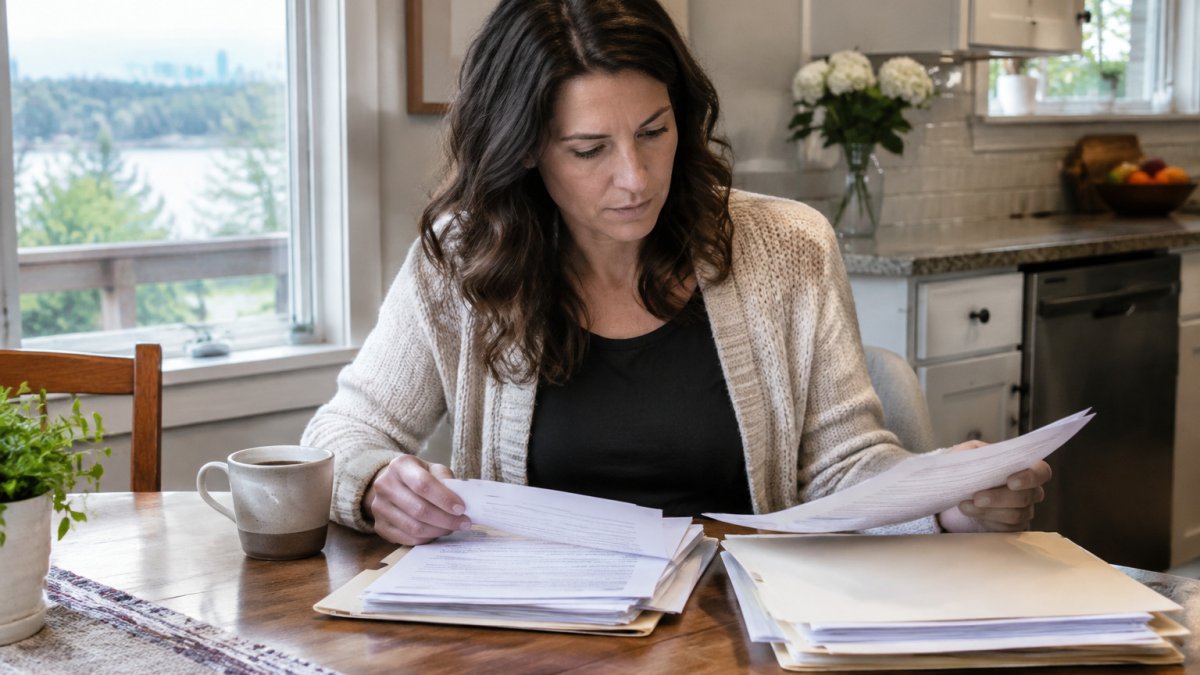
!An adult daughter sitting at a kitchen table in a Vancouver, Washington home, sorting a stack of papers and a folder of estate documents beside a cup of coffee
Building a Probate Inventory of Assets
Once the case is open, the executor usually must list the estate's assets. This is often called an inventory, and it is one of the key documents needed for probate court. It covers property the deceased owned at the time of death. Because the inventory identifies property that may need to be sold to settle the estate, understanding how probate property sales fit into the process can help clarify what happens next.
Gather these records to build the list:
- Bank statements and account numbers
- Deeds and property records
- Insurance policies and beneficiary designations
- Recent tax returns
- Vehicle titles
- Retirement account statements
Review each item carefully so you do not list something that the court does not control.
How to Get Probate Documents Online and Where to File Them
Many probate forms are posted on court websites, and the path from download to filed case follows a sequence. Following it in order prevents the most common delays.
Step 1: Locate the current forms
Start at the probate court's own website for the county where the deceased lived at the time of death. Look for a "forms," "probate," or "self-help" page. Download the petition or application, the personal representative acceptance form, the notice forms, and any inventory or accounting forms the court lists.
Step 2: Confirm local requirements before you fill anything out
Call or visit the clerk's office and ask three questions:
- Which form set is current for this type of estate?
- Is electronic filing accepted, and through which portal?
- Does the court require original documents delivered in person, or are scanned copies acceptable at filing?
Ask for the current filing fee at the same time. Fees are set by each court and change, so confirm the amount rather than relying on a figure from an older guide.
Step 3: Complete and sign the paperwork
Fill out the petition with the deceased's legal name, date of death, county of residence, and a summary of the estate. The proposed personal representative signs the acceptance form. If the form requires notarization, sign in front of the notary, not before. Attach the original will and any codicils, and include the certified death certificate if the court's checklist calls for it at filing.
Step 4: File with the clerk
File at the probate clerk's office for the county superior court or its equivalent. If the court accepts electronic filing, submit through its portal and keep the confirmation. If it requires paper, bring the original plus a full copy set, and ask the clerk to stamp your copy as received. Pay the filing fee and keep the receipt.
Step 5: Serve notice on heirs and beneficiaries
After filing, the court typically sets a deadline for notifying heirs, beneficiaries, and sometimes creditors. Serve the notice in the manner the court requires, often by mail with proof of service, sometimes by publication. File the proof of service with the clerk by the deadline. Missing a notice deadline is one of the most common reasons an appointment is delayed.
Step 6: Obtain the appointment papers
Once the court reviews the petition and any required notices, it issues letters testamentary (if there was a will) or letters of administration (if there was not). These are the documents that prove the personal representative's authority. Banks, title companies, and insurers will ask for a certified copy, so request several. The estate cannot be administered, accounts closed, property transferred, debts paid, until these letters are in hand.
Step 7: File the inventory and keep the record
After appointment, the personal representative typically files an inventory of estate assets and, later, an accounting. Check the court's deadlines for each. Keep a single folder, paper or digital, with the petition, the stamped copy, the letters, the proof of service, the inventory, and every receipt.
Watch out: opening an estate in the wrong county can cause delays, confirm with the clerk which county the case belongs in.
When a Key Document Is Missing or No Will Exists
Sometimes the original will cannot be found. Other times no will was ever written.
If the will is missing, search the deceased's home, safe deposit box, and attorney's office first. Ask the clerk what the court requires before accepting a copy.
If no will exists, the estate passes under state law. Ask the clerk which paperwork the court requires.
Because these cases can be harder, consider consulting a licensed probate attorney. Legal questions should go to a licensed attorney.
Scheduling Your Next Step With WTS Solutions
Gathering probate documents is one of the hardest parts of settling an estate, especially while you are grieving. You do not have to sort it all out alone. Connect with WTS Solutions to talk through your timeline, your paperwork, and the practical steps that come next. Our team can help you stay organized so you can focus on your family.
Frequently Asked Questions
What documents do I need to start probate?
Most probate courts ask for the original will, a certified copy of the death certificate, a petition or application to open probate, and a list of the deceased person's known assets and debts. Requirements vary by jurisdiction, so confirm the exact forms with the county clerk handling the estate before you file. Gathering these items early keeps the case moving and reduces the chance of a rejected filing.
Do I need the original will to file for probate?
In most cases, the court needs the original signed will, not a photocopy, so it can be filed with the clerk. If the original cannot be found, ask the clerk what the court requires. Store the original safely and avoid making notes on it, as changes can complicate the case.
Do I need an inventory of assets for probate court?
Many probate courts require an inventory of the estate's assets. Confirm with the court what the inventory must include and when it is due. Pull together bank statements, property records and insurance policies to build an accurate list.
Can I get probate documents online?
Many courts publish probate forms online, but not every document can be obtained or submitted online. Certified copies of death certificates must be ordered from the vital records office. Check the specific court's website or call the clerk to confirm which steps you can complete online in Vancouver, Washington.