 how-to
How to Manage Sibling Inheritance Disagreements
Table of Contents
- Why Sibling Inheritance Disagreements Happen
- How to Talk to Siblings About Inheritance Before Conflict Escalates
- The Estate Mediation Process: A Path Before Litigation
- Legal Options When Sibling Inheritance Disagreements Turn Serious
- Asset Liquidation and Equitable Distribution of the Estate
- The Psychological Impact on Families and When to Seek Help
- Steps to Protect the Estate and Prevent Future Disputes
- Conclusion
Last Updated: August 12, 2026
Why Sibling Inheritance Disagreements Happen
Sibling inheritance disagreements are among the most painful conflicts a family can face, arriving when grief is already heaviest. At WTS Solutions, we've seen firsthand how quickly a parent's passing can fracture relationships built over decades. Understanding why these disputes start is the first step toward preventing them from consuming the estate and the family.
The root causes are rarely just about money. They're about perceived fairness, old wounds, and the meaning people attach to objects and decisions made years before anyone died.
Unequal Distribution and Perceived Favoritism
Unequal distribution is the most common trigger for sibling inheritance disagreements. A will leaving one child a larger share often isn't the problem itself, it's the absence of explanation. When beneficiaries don't understand why a parent made a particular choice, they fill the silence with the worst possible interpretation: favoritism, manipulation, or rejection.
Disputes over unequal shares frequently escalate into formal will contests, where one beneficiary argues the deceased lacked testamentary capacity or was subject to undue influence. These legal challenges are expensive, slow, and emotionally corrosive. Probate courts can take months or years to resolve contested estates, and legal fees can consume a substantial portion of the estate assets.
The executor also becomes a target. If one sibling serves as executor, others may question every decision, accusing them of breaching their fiduciary duty or favoring their own interests. This is where estate administration breaks down fastest.
Disputes Over Sentimental Items and Digital Assets
The fiercest fights are rarely about the house or bank account. They're about the kitchen table, wedding photographs, and handwritten recipe cards. Sentimental items have no obvious market value, which means there's no objective way to divide them, and every sibling's claim feels equally valid.
Digital assets add newer complexity. According to the Uniform Law Commission's guidance on digital assets and fiduciaries, most states have adopted frameworks allowing executors to access a decedent's digital accounts, but many families remain unaware that email archives, cloud photo libraries, subscription accounts, and cryptocurrency holdings are part of the estate. When these assets go unaddressed in a will, conflict is almost guaranteed.
How to Talk to Siblings About Inheritance Before Conflict Escalates
The single most effective way to manage sibling inheritance disagreements is to have the hard conversation before the estate enters probate. Families that communicate openly while a parent is still alive or immediately after a death, before positions harden, resolve disputes far more quickly and with less damage to relationships.
The goal isn't perfect agreement. It's to create a shared understanding of the process, the assets, and each person's priorities.
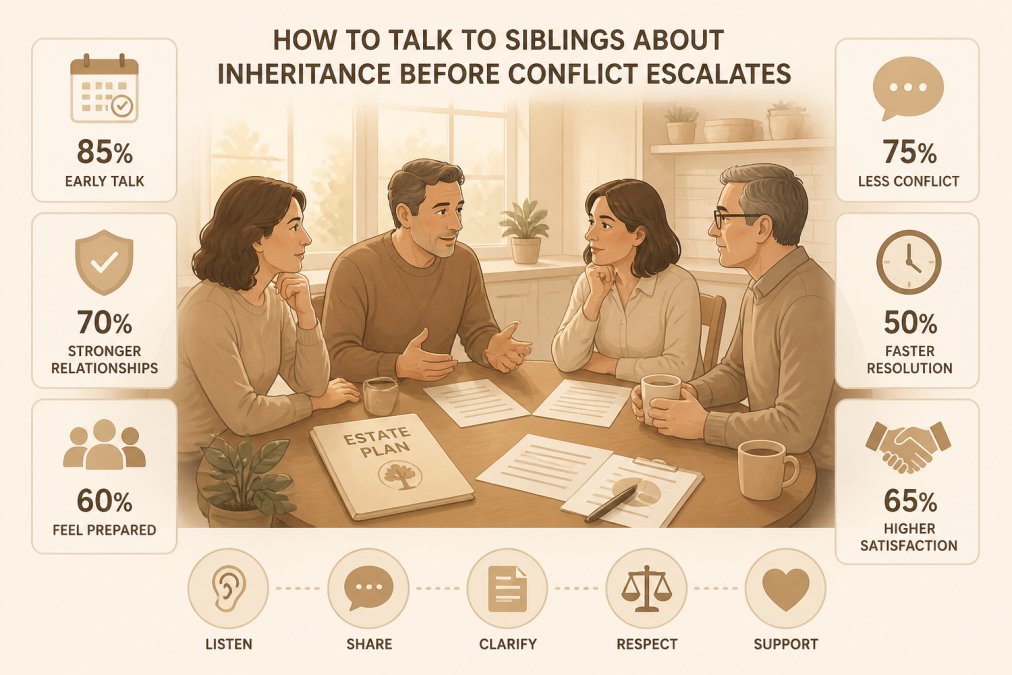
Start by establishing ground rules: no decisions get made in the first meeting, everyone gets to speak, and the goal is to understand each other's concerns before problem-solving begins. Bring a written agenda to keep the conversation focused. If emotions run high, schedule a second meeting rather than pushing through to a resolution nobody actually agrees with.
Checklist for a Pre-Settlement Family Meeting
Use this checklist before or shortly after a parent's passing to structure the first family conversation about the estate.
- Confirm the location of the will and any trust documents
- Identify who the named executor or trustee is
- List all known estate assets: real property, financial accounts, vehicles, personal property, and digital assets
- Ask each sibling to write down their top three priorities before the meeting
- Agree on a communication channel so no one feels left out of decisions
- Discuss whether a neutral third party, such as an estate attorney or mediator, should be present
- Set a timeline for key decisions and stick to it
- Address sentimental items separately from financial assets
- Document every decision made in the meeting in writing
The written record is non-negotiable. Verbal agreements during emotionally charged meetings are forgotten or misremembered. A simple shared document prevents "that's not what we said" from derailing progress weeks later.
The Estate Mediation Process: A Path Before Litigation
Mediation is the most underused tool in estate conflict resolution. The estate mediation process involves a neutral, trained third party who helps disputing beneficiaries reach a voluntary settlement agreement without going to court. It's confidential, typically faster than litigation, and preserves far more of the estate for beneficiaries rather than attorneys.
Most families don't realize mediation is available until they're already deep in litigation. That's a costly mistake.
| Stage | What Happens | Typical Duration |
|---|---|---|
| Initial consultation | Mediator reviews estate documents and dispute summary | 1-2 sessions |
| Joint sessions | All parties meet to identify core issues and interests | 2-4 sessions |
| Private caucuses | Mediator meets separately with each party | As needed |
| Settlement drafting | Agreement is written and reviewed by legal counsel | 1-2 weeks |
| Finalization | Signed settlement agreement is filed with probate court | 1-4 weeks |
When to Bring In a Neutral Third Party
Bring in a neutral third party the moment communication breaks down. If siblings are no longer speaking directly, if accusations of undue influence or fiduciary misconduct have been made, or if any party has retained legal counsel, informal family discussions are no longer sufficient.
A professional mediator or estate attorney can reframe the conversation from adversarial to problem-solving. According to the American Bar Association's resources on estate planning and dispute resolution, mediated settlements in estate disputes have a high completion rate compared to litigated cases, and parties typically report higher satisfaction with outcomes they helped negotiate themselves.
The mediator doesn't make decisions. That distinction matters enormously to families who fear losing control of the process.
Legal Options When Sibling Inheritance Disagreements Turn Serious
Sometimes disputes can't be resolved through conversation or mediation. Sibling inheritance disagreements involving allegations of fraud, undue influence, or executor misconduct require legal intervention. Knowing your options before you need them prevents panic-driven decisions that make things worse.
Contesting a Will and Proving Undue Influence
A will contest is a formal legal challenge filed in probate court. To succeed, the contesting party must prove one of a narrow set of grounds: lack of testamentary capacity, undue influence, fraud, or improper execution.
Undue influence is the most commonly alleged ground and the hardest to prove. Courts look at whether the influencing party had a close relationship with the deceased, whether the deceased was vulnerable, and whether the will's provisions are inconsistent with prior stated wishes. Evidence matters: medical records, prior versions of the will, and witness testimony all become critical.
Will contests are expensive and time-consuming. Even a successful challenge can take years and consume a significant portion of the estate in legal fees. Exhaust mediation and negotiation first.
Understanding the Executor's Fiduciary Duty
Fiduciary duty is the legal obligation of an executor or trustee to act in the best interests of all beneficiaries, not their own interests or those of any one sibling. This duty includes managing estate assets prudently, distributing assets according to the will or trust, keeping accurate records, and communicating transparently with all beneficiaries.
An executor who self-deals, delays administration without cause, or withholds information from beneficiaries can be removed by the probate court and held personally liable for losses. Beneficiaries who suspect a breach of fiduciary duty should consult an estate attorney promptly; delays in raising these concerns can complicate the legal remedy.
Asset Liquidation and Equitable Distribution of the Estate
Liquidating estate assets to ensure equitable distribution is often the most practical path forward when siblings can't agree on who gets what. Asset liquidation converts physical property into cash, which is then divided according to the will or a negotiated settlement agreement. It removes subjective value disputes from the equation.
The process typically involves a professional estate sale or auction coordinated through an estate sale company. A well-run estate sale maximizes the value of belongings and ensures items are priced fairly based on current market conditions rather than emotional attachment.
WTS Solutions partners with experienced estate sale companies to coordinate this process for families, handling the logistics of asset transition so beneficiaries can focus on reaching agreement rather than managing physical details. For real property, an independent real estate appraisal establishes a fair market value baseline. If siblings disagree about whether to sell or one sibling wants to buy out the others, that appraisal gives everyone a neutral starting point. As noted in IRS guidance on estate tax and property valuation, proper valuation of estate assets also affects the estate's tax position, which makes professional appraisal doubly important.
The Psychological Impact on Families and When to Seek Help
The legal and financial dimensions of inheritance disputes get most attention. The psychological damage gets almost none. This is a serious gap.

Sibling inheritance disagreements don't just damage bank accounts. They damage identities. Adult children who expected close sibling relationships to survive their parents' deaths are often blindsided by how quickly grief and money combine into something corrosive. The conflict activates old family dynamics, resurfaces childhood resentments, and forces people to make high-stakes decisions while they are least equipped to do so.
Family therapy is a legitimate tool in this context, not a last resort. A therapist specializing in grief and family systems can help siblings separate emotional reactions from legal decisions, which is exactly what's needed to reach durable agreements. Some mediators work alongside therapists for precisely this reason.
Grief itself can impair judgment in ways that aren't obvious. Decisions made in the acute phase of bereavement are often regretted later. Where possible, avoid making irreversible decisions about estate assets in the first weeks after a death.
Steps to Protect the Estate and Prevent Future Disputes
The most effective approach to sibling inheritance disagreements is prevention. Families that plan carefully before a death occurs face dramatically fewer conflicts afterward.
For the estate owner (while living):
- Work with an estate planning attorney to create a clear, current will or revocable living trust. Ambiguous language is the single biggest source of probate disputes.
- Name a neutral executor or professional trustee if sibling conflict is anticipated. A professional trustee has no personal stake in family dynamics.
- Write a letter of instruction explaining your reasoning for specific bequests. This document isn't legally binding, but it answers the "why" question that drives so many disputes.
- Address digital assets explicitly. List accounts, access credentials, and instructions in a secure document and reference it in your estate plan.
- Hold a family meeting while you're alive to discuss your wishes. Families that have this conversation in advance report far less conflict during estate administration.
For beneficiaries managing an active dispute:
- Retain independent legal counsel early. Each sibling should have their own attorney.
- Request a full accounting from the executor. Beneficiaries have the right to information about estate assets and administration decisions.
- Document all communications in writing.
- Pursue mediation before litigation. Court proceedings are slow, expensive, and public.
- Separate sentimental items from financial assets in negotiations. Treat them as two distinct categories with different resolution processes.
Tax implications deserve specific attention. Contested estate settlements can have tax consequences that beneficiaries don't anticipate. When a settlement agreement redistributes assets differently from the original will, the tax treatment of those assets may change. Consulting a tax professional or CPA before finalizing any settlement agreement is essential to avoid surprises that reduce the actual value of what each beneficiary receives.
Managing sibling inheritance disagreements requires navigating legal complexity, financial decisions, and family relationships simultaneously, often while grieving. The burden on families is real, and the stakes are high. WTS Solutions provides compassionate, hands-on support to families at exactly this stage: coordinating estate sales, managing the logistics of clearing out a loved one's home, and connecting families with the qualified professionals they need for probate and asset liquidation. Connect with WTS Solutions to get expert guidance through the estate transition process and focus on what matters most during a difficult time.
Frequently Asked Questions
How common are sibling inheritance disputes?
Inheritance disputes among siblings are more common than most families expect. Grief, long-standing family tensions, and perceived unfairness in asset distribution all contribute. Disputes frequently arise over real property, sentimental belongings, and unequal shares named in a will. Probate courts across the country handle thousands of contested estate cases each year, making early communication and clear estate planning the most reliable ways to reduce the risk of a drawn-out legal conflict.
Can mediation actually resolve a family inheritance conflict?
Yes. The estate mediation process gives all beneficiaries a structured setting to voice concerns with a neutral third party guiding the conversation. Unlike court proceedings, mediation is private, typically faster, and far less expensive than litigation. A mediator does not decide the outcome but helps siblings reach a voluntary settlement agreement. Many families find that mediation preserves relationships in a way that adversarial legal action rarely does, making it a strong first step before hiring an estate litigation attorney.
When should you hire an estate litigation attorney?
Hire an estate litigation attorney when informal negotiation and the estate mediation process have both failed, when you have credible evidence of undue influence or lack of testamentary capacity in the will, or when an executor appears to be breaching their fiduciary duty. Legal counsel is also advisable if the estate is large, if beneficiary rights are being ignored during estate administration, or if a sibling is removing or hiding estate assets without authorization.
What are the tax implications of a contested inheritance settlement?
A contested estate settlement can trigger tax consequences that beneficiaries often overlook. Assets received through a negotiated settlement agreement may still be subject to federal estate tax if the total estate exceeds the IRS exemption threshold. Inherited property generally receives a stepped-up cost basis, which reduces capital gains tax when sold, but this benefit can be complicated by litigation delays or asset liquidation arrangements. Consulting a tax professional alongside your legal counsel during probate is strongly recommended.
This article was written using GrandRanker