 how-to
How to Manage Probate in Vancouver, WA
Table of Contents
- Understanding Probate and When You Need It
- Small Estate Affidavit Requirements and Alternatives
- Step-by-Step: How to File a Probate Petition
- Duties of a Personal Representative in Washington
- Washington State Probate Timeline and Process
- Costs and Fees Associated with Probate
- Common Mistakes to Avoid
- Conclusion
Last Updated: August 15, 2026
Understanding Probate and When You Need It
Probate is the legal process through which a court validates a will, identifies heirs, pays debts and taxes, and distributes remaining assets to beneficiaries. Not every estate requires probate, assets held in joint tenancy, transferred through beneficiary designations, or placed in a living trust pass directly to heirs outside the probate system. However, if significant assets sit solely in the decedent's name, probate becomes necessary to legally transfer ownership.
Probate provides a structured, court-supervised method for settling an estate fairly. Creditors receive notice and can file claims. Beneficiaries have transparency into asset management. The personal representative operates under court oversight, protecting everyone involved and creating a clear legal record of settlement. Washington State probate law is codified in the Revised Code of Washington (RCW) Chapter 11. Most straightforward estates take between nine months and two years to close.
Small Estate Affidavit Requirements and Alternatives
Washington State recognizes that not every estate needs full probate machinery. If the deceased person's total estate value falls below $40,000 in personal property and meets other requirements, beneficiaries can use a small estate affidavit to transfer assets without court involvement.
A small estate affidavit is a legal document signed by a beneficiary or heir stating that the estate qualifies for simplified administration. To use this process, at least 40 days must have passed since death, and the filer must be entitled to inherit under Washington's intestacy laws or be named in the will. Once prepared and signed, you present it to banks and financial institutions, which are required by law to release assets without a court order. This eliminates court filing fees and typically takes weeks rather than months.
However, the small estate affidavit has limitations. It only works for personal property, not real estate. If the estate includes a house or land, you'll need full probate to transfer title, even if the total value is under $40,000. If there are significant debts, contested claims, or family disputes, the small estate process won't provide the court oversight that formal probate offers.
Another alternative is a living trust. If the deceased created a revocable living trust and properly funded it during their lifetime, assets held in the trust's name pass directly to beneficiaries without probate. This requires advance planning but is one of the most effective probate avoidance strategies available.
WTS Solutions can help clarify which path makes sense for your situation. Whether you're navigating a small estate affidavit or preparing for full probate administration, understanding your options upfront prevents costly mistakes later.
Step-by-Step: How to File a Probate Petition
Filing a probate petition with the superior court clerk is the formal beginning of probate. This petition asks the court to open the estate for administration and, if there's a will, to validate it.

Gather Required Documents
Before filing, assemble the original will (if one exists), a certified copy of the death certificate, and information about all assets: bank statements, investment accounts, property deeds, vehicle titles, and insurance policies. Create an inventory of debts: mortgage statements, credit card bills, and medical bills. Identify all potential heirs or beneficiaries and gather information about the personal representative you're naming, typically the executor named in the will or a family member willing to serve. The personal representative must be at least 18 years old and a resident of Washington State.
Complete the Petition Form
The petition is a formal court document filed with the superior court clerk. Washington provides standardized forms available through the court's website or clerk's office. The petition must include the decedent's full legal name, date and place of death, and whether the person died testate (with a will) or intestate. List all known heirs and beneficiaries by name and relationship. Describe the estate's assets in general terms and state the estimated total value. Name the person you're requesting the court appoint as personal representative and include their consent to serve. The petition must be signed under penalty of perjury and may require notarization depending on local court rules.
File with the Superior Court Clerk
File the completed petition with the superior court clerk in the county where the deceased person lived at the time of death. If the decedent owned real property in Washington but lived elsewhere, file in the county where the property is located. Filing fees vary by county but typically range based on estate value. After filing, the court will schedule a hearing on your petition. Once approved, the court issues letters testamentary (if there's a will) or letters of administration (if there's no will). These documents prove to banks, title companies, and other institutions that the personal representative has authority to act on behalf of the estate.
Duties of a Personal Representative in Washington
The personal representative carries significant legal and fiduciary responsibilities. Washington law imposes strict duties on this person, and failure to fulfill them can result in personal liability.
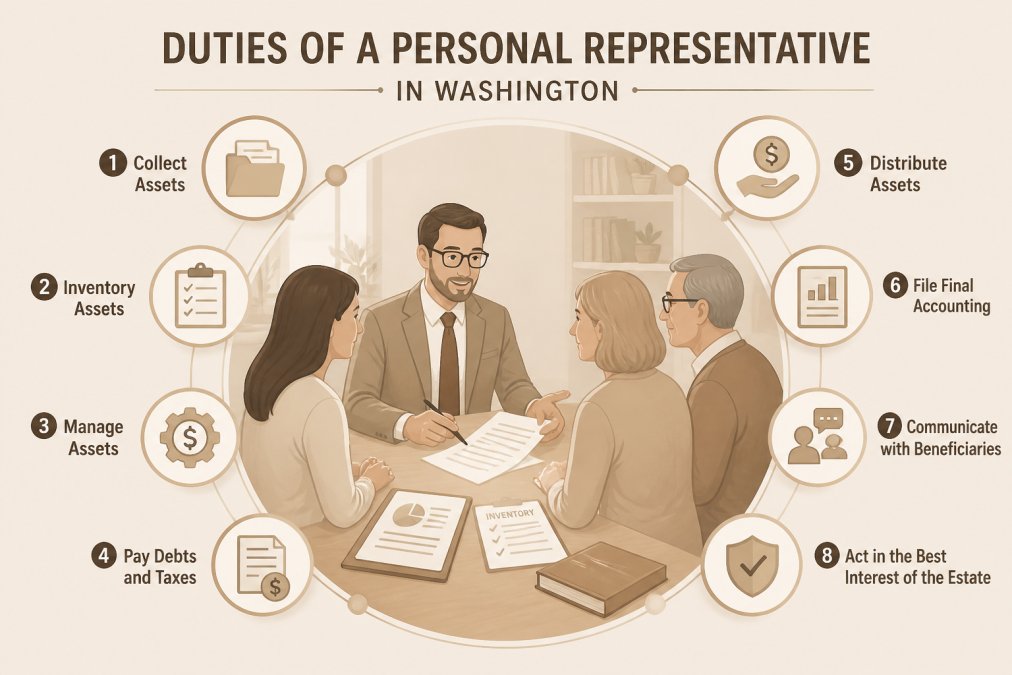
The first duty is to inventory and appraise estate assets. Within a reasonable time after appointment, the personal representative must identify all property owned by the decedent, determine its value as of the date of death, and file an inventory with the court. They must also provide notice to all known creditors and publish notice in a local newspaper, giving creditors a deadline, typically four months from publication, to file claims against the estate.
Managing estate assets during administration is another core duty. The personal representative must preserve property, pay ongoing expenses like property taxes and insurance, and invest idle funds prudently. They cannot use estate assets for personal benefit and must keep detailed records of all transactions. The personal representative must also handle tax obligations, including filing the decedent's final income tax return and, if the estate is large enough, federal and state estate tax returns. Washington has no state estate tax, but federal estate taxes apply to estates exceeding $13.61 million in 2026.
Finally, the personal representative must prepare a final accounting showing all receipts and disbursements, and distribute remaining assets to beneficiaries according to the will or Washington's intestacy statutes. WTS Solutions helps personal representatives navigate these responsibilities by coordinating with specialized professionals, estate sale companies for asset liquidation, move management services for clearing properties, and legal advisors for complex decisions.
Washington State Probate Timeline and Process
Understanding the timeline for probate administration helps families set realistic expectations. After the petition is filed and approved, notice must be given to all heirs, beneficiaries, and creditors. The notice period for creditors is typically four months. Asset inventory and appraisal usually takes two to three months. During this period, the personal representative begins paying valid debts and estate expenses, including funeral costs, court filing fees, attorney fees, and property maintenance.
The middle phase involves managing the estate's affairs. If there are disputes over the will's validity, creditor claims to contest, or complex assets to liquidate, this phase can extend significantly. The final phase involves preparing the final accounting, obtaining court approval, and distributing assets to beneficiaries. This typically occurs nine to eighteen months after the petition is filed, though straightforward estates can close sooner and complex ones take considerably longer.
Several factors extend the timeline. If the estate includes real property that must be sold, the sale process adds three to six months. Will contests or disputes among beneficiaries can extend the process by a year or more. Significant taxes or debts, non-resident beneficiaries, or missing heirs also delay distribution.
Costs and Fees Associated with Probate
Probate involves multiple expenses that reduce the amount available for distribution to beneficiaries. Court filing fees vary by county and are typically based on estate value. Publication fees for notice to creditors range from $50 to $200. Attorney fees are often the largest expense, and many personal representatives hire a probate attorney to handle petition preparation, court filings, and legal guidance. Attorney fees may be charged hourly or as a percentage of estate value. Washington law allows reasonable attorney fees to be paid from estate assets.
Appraiser fees apply when professional valuation is needed for real property, businesses, or valuable personal property. If the estate includes real property that must be sold, real estate agent commissions typically run 5-6% of the sale price. Estate sale companies help liquidate personal property and household goods, typically charging 30-40% of gross sales proceeds. Probate bond fees may apply if the court requires a personal representative to post a bond.
The total cost of probate typically ranges from 3-7% of the estate value for straightforward estates. For a $500,000 estate, this might mean $15,000 to $35,000 in total probate costs. This is why many families explore probate avoidance strategies like living trusts or small estate affidavits when possible.
Common Mistakes to Avoid
Families managing probate often make preventable mistakes that delay the process, increase costs, or create legal problems. Failing to file the probate petition promptly is the first common mistake. While Washington law doesn't impose a strict deadline, delays create problems. Filing the petition within a few months of death starts the process moving and establishes clear authority for the personal representative.
Inadequate notice to interested parties is another frequent error. Washington requires specific notice procedures to heirs, beneficiaries, and creditors. Failing to provide proper notice can invalidate the probate process, requiring the entire process to restart. Many personal representatives fail to maintain detailed records of all transactions. The court requires a complete record of all receipts and disbursements. Without documentation, the personal representative cannot satisfy the court's requirements and may face personal liability.
Commingling estate assets with personal funds is a serious mistake. The personal representative must keep estate money in a separate account, clearly labeled as an estate account. Some personal representatives distribute assets to beneficiaries before resolving all debts and taxes, creating a situation where the estate lacks funds to pay creditors or tax obligations.
Failing to pay estate taxes or file required tax returns is another costly mistake. The personal representative must file the decedent's final income tax return and, if required, federal and state estate tax returns. Digital assets present a modern challenge many families overlook, email accounts, social media profiles, cryptocurrency holdings, and online banking accounts must be identified and managed.
Finally, some families attempt to handle complex probate matters without professional guidance. While straightforward estates can sometimes be managed without an attorney, most benefit from at least a consultation with a probate attorney. WTS Solutions helps families avoid these mistakes by coordinating with qualified professionals.
Managing probate in Washington State is complex, but understanding the process, timeline, and requirements helps families navigate it successfully. The process begins with determining whether your estate qualifies for simplified administration or requires full probate, then proceeds through filing, asset management, and distribution. Throughout, the personal representative bears significant responsibilities and must comply with strict legal requirements.
Professional support, from attorneys handling legal matters to specialized coordinators managing practical aspects, makes the process smoother and less overwhelming. At WTS Solutions, we bridge the gap between families and the professionals they need. From probate guidance to estate sale coordination to comprehensive move management for clearing properties and facilities, we handle the logistics of asset transition with care, allowing you to focus on what matters most during this difficult time.
Washington State Revised Code Chapter 11 on Probate
Superior Court Clerk's Office probate petition forms and filing requirements
IRS Estate Tax information and thresholds for 2026
Frequently Asked Questions
How long does probate take in Washington State after death?
Probate timelines vary based on estate complexity and whether the will is contested. A straightforward probate typically takes 6 to 12 months in Washington State. More complex estates with significant assets, multiple beneficiaries, or creditor claims may extend 12 to 18 months or longer. The Washington State probate timeline begins when you file the petition with the Superior Court Clerk and continues through final accounting and asset distribution to beneficiaries.
When is a small estate affidavit used instead of probate?
Washington allows small estate affidavits when the total estate value is $40,000 or less (excluding real property). Small estate affidavit requirements include filing an affidavit with the Superior Court Clerk, waiting 40 days after the death, and providing notice to creditors. This streamlined process avoids formal probate and reduces court fees and timelines significantly, making it ideal for modest estates with minimal assets and straightforward distribution.
What are the main duties of a personal representative in Washington?
The personal representative (executor) has fiduciary duty to act in the beneficiaries' best interest. Key duties of a personal representative in Washington include securing estate assets, notifying creditors and beneficiaries, creating an inventory and appraisal of all property, paying valid debts and taxes, and distributing remaining assets according to the will or intestate succession laws. You must file a final accounting with the court and obtain approval before closing the estate.
How much does probate cost in Washington?
Probate costs include court filing fees (typically $200-$500), Superior Court Clerk fees, publication costs for creditor notices, and potentially attorney fees if you hire legal counsel. Washington allows statutory fees for personal representatives based on estate value. Total costs depend on estate complexity, asset types, and whether disputes arise. For a detailed estimate specific to your situation, contact WTS Solutions for a consultation and cost assessment.
This article was written using GrandRanker