 how-to
How Much Involvement Is Required for Probate
Table of Contents
- What Probate Actually Requires From You
- Which Assets Require Probate Court Oversight
- Executor Responsibilities Checklist: Task by Task
- How Long Does Probate Take From Filing to Close
- The Emotional Toll of Probate Involvement
- Hiring a Probate Attorney: Do You Actually Need One?
- Costs and Fees That Come With Probate
- Conclusion
Last Updated: August 11, 2026
What Probate Actually Requires From You
Probate is the court-supervised legal process of validating a deceased person's will, settling their debts, and distributing assets to heirs and beneficiaries. The level of involvement depends on three factors: whether the decedent left a valid will, the size and complexity of the estate, and the state in which probate is filed. Some estates close in a few months with minimal court contact; others stretch for a year or longer, demanding regular appearances, filings, and decisions from the personal representative.
How much involvement is required also varies by role. If you're named executor, you carry a fiduciary duty to the estate and its beneficiaries. If you're simply an heir, your involvement may be limited to responding to notices and signing distribution paperwork.
Testate vs. Intestate: Does a Will Change Your Workload?
Atestate estate is one where the decedent left a valid will. An intestate estate is one where no valid will exists. With a valid will, the executor's path is clearer: present the will to probate court, receive letters testamentary, and follow the document's instructions. Without a will, the court appoints an administrator and applies intestate succession rules, which can slow every stage of the process and increase your involvement considerably.
Formal Administration vs. Summary Administration
Formal administration is the full probate process: court filings, creditor notice periods, inventory and appraisal, and supervised distribution of assets. Summary administration is a simplified process available for smaller estates, often where the total value falls below the state's probate threshold. Many states allow families to transfer assets using a small estate affidavit without any court appearance at all. Check your state's specific probate threshold with the Uniform Law Commission's estate planning resources to see whether summary administration applies.
Which Assets Require Probate Court Oversight
Not every asset a person owned at death goes through probate. Probate assets are those held solely in the decedent's name with no designated beneficiary. Non-probate assets pass directly to a named beneficiary or co-owner, bypassing the court entirely.
Common probate assets include real property titled only in the decedent's name, bank accounts without a payable-on-death designation, personal property such as vehicles and jewelry, and business interests without a succession agreement. The size of the probate estate determines how much court involvement you'll face.
Assets That Bypass Probate Entirely
Several asset types transfer automatically at death, regardless of what a will says. Life insurance policies with a named beneficiary, retirement accounts such as IRAs and 401(k)s with designated beneficiaries, jointly held property with right of survivorship, assets held in a revocable living trust, and bank accounts with payable-on-death designations all bypass probate. According to the American Bar Association's guide to estate planning, proper beneficiary designations made during life are one of the most effective ways to reduce the burden on families after death.
Digital Assets and What Executors Often Overlook
Online accounts, cryptocurrency holdings, subscription services, and digital media libraries all require attention. Many states have adopted the Revised Uniform Fiduciary Access to Digital Assets Act, which governs how executors can legally access these accounts. Search the decedent's email for account confirmation messages, check password managers, contact platforms directly with a death certificate and letters testamentary, and cancel recurring subscriptions to stop unnecessary charges to the estate. Overlooking digital assets can mean lost value and prolonged estate administration.
Executor Responsibilities Checklist: Task by Task
The personal representative carries the full administrative weight of the estate. Here is a practical executor responsibilities checklist organized by phase.
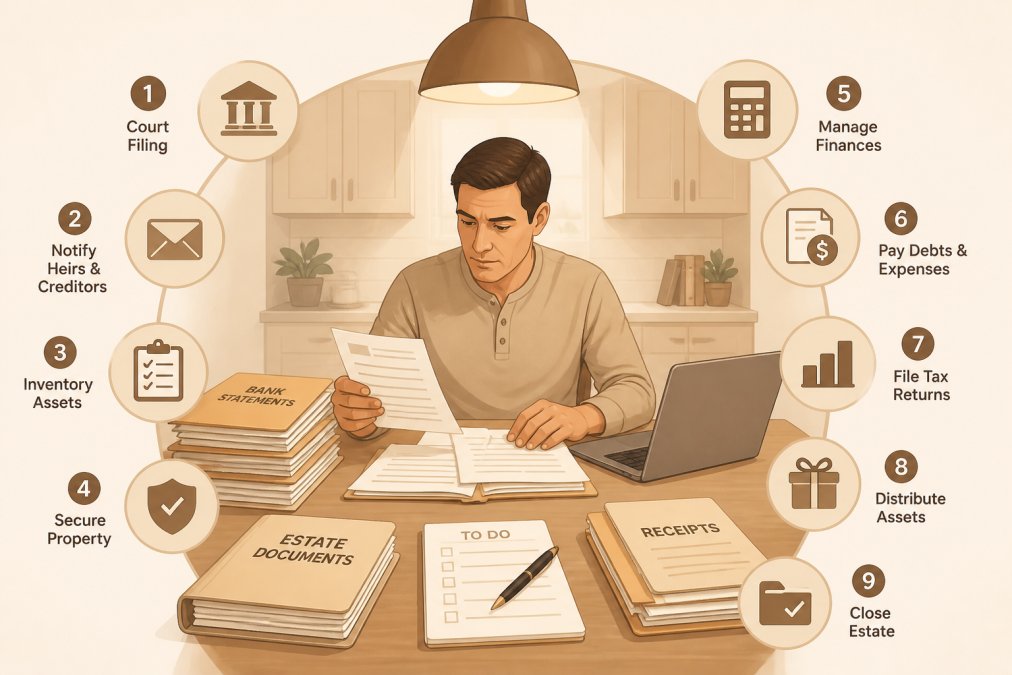
Phase 1: Immediate Steps (Week 1-2)
- Obtain multiple certified copies of the death certificate
- Locate and secure the original will
- File the will with the probate court and petition for formal administration
- Notify Social Security and any pension administrators
- Secure and inventory all physical property
Phase 2: Court and Legal (Weeks 2-8)
- Receive letters testamentary from the court
- Open an estate bank account
- Publish legal notice to creditors as required by state law
- Complete a full inventory and appraisal of probate assets
- Notify known creditors in writing
Phase 3: Administration (Months 2-6)
- Pay valid creditor claims from estate funds
- File the decedent's final income tax return
- Determine whether an estate tax return is required
- Manage and maintain estate property during the process
- Address any will contest or disputes among heirs
Phase 4: Distribution and Close (Months 6-12+)
- Petition the court for approval of distribution
- Execute title transfers for real property and vehicles
- Distribute assets to beneficiaries per the will or intestate succession
- File a final accounting with the court
- Petition to close the estate
Realistic Time Estimates for Each Task
| Task | Estimated Time Commitment |
|---|---|
| Gathering death certificates and filing petition | 4-8 hours |
| Completing asset inventory and appraisal | 8-20 hours |
| Publishing creditor notice and waiting period | Passive; 2-5 months |
| Paying debts and filing tax returns | 6-15 hours |
| Coordinating property sale or transfer | 5-30 hours depending on complexity |
| Preparing final accounting and distribution | 4-10 hours |
| Court appearances and correspondence | 2-8 hours total |
Complex estates with business interests, out-of-state property, or family disputes can multiply these figures several times over.
How Long Does Probate Take From Filing to Close
Probate typically takes between six months and two years to complete, depending on estate complexity and state-specific procedures. Most straightforward estates close within nine to twelve months.
The main factors that extend the timeline include creditor notice periods (most states require two to five months after publishing legal notice before distribution), tax obligations (the IRS has a statutory period to review estate tax returns), will contests, real property sales, and court scheduling backlogs. For families wondering how much involvement is required for probate over this extended period, the workload is front-loaded. The first two months are the most demanding, after which much of the process is waiting with periodic tasks in between.
The Emotional Toll of Probate Involvement
Probate is not just a legal process. For most executors, it runs concurrently with grief. You're making financial decisions, dealing with creditors, and managing family expectations while processing the loss of someone you loved.

Common emotional challenges executors report include decision fatigue from constant administrative choices, guilt over selling or distributing items with sentimental value, family tension when relatives disagree on asset distribution, anxiety over making legal mistakes, and physical exhaustion from clearing out a parent's home while managing paperwork. The role carries real psychological weight beyond legal requirements.
Building a support structure matters. Whether that means delegating physical tasks, working with a professional who handles the logistics of property clearance and estate coordination, or simply giving yourself permission to take breaks, the emotional dimension of probate involvement deserves attention.
Hiring a Probate Attorney: Do You Actually Need One?
Not every estate requires an attorney. Small, simple estates with clear titles, no disputes, and assets that largely bypass probate can often be administered without legal counsel. The complexity of the estate, not its size alone, should drive this decision. A modest estate with a contested will is far more legally demanding than a large estate with clean documentation.
A Simple Checklist: When Professional Help Is Worth It
Hire a probate attorney if:
- The estate includes real property in more than one state
- The will is being contested by any heir or interested party
- The decedent had significant debts or creditor disputes
- The estate may owe federal or state estate taxes
- There are minor or disabled beneficiaries involved
- The executor has a conflict of interest with any beneficiary
- The decedent died intestate and heirs are disputed
- You have no prior experience with legal filings or court procedures
You may be able to proceed without an attorney if:
- The estate qualifies for summary administration or a small estate affidavit
- All assets have clear beneficiary designations or joint ownership
- All heirs are in agreement and no disputes exist
- The estate consists of straightforward personal property only
- Your state provides a simple probate process with court-provided forms
Costs and Fees That Come With Probate
Probate is not free. The major cost categories include court filing fees, attorney fees, executor compensation, appraisal fees, and accounting fees.
Court filing fees vary by state and estate value but are typically modest. Attorney fees represent the largest variable expense, charged either hourly or as a percentage of the gross estate value depending on state law. Executor compensation is typically set by state statute as a percentage of the estate's value, though executors may waive this fee. Appraisal fees apply when estate property requires professional valuation. Accounting fees arise when the estate has complex tax obligations.
The total cost of probate commonly runs from a few hundred dollars for simple summary administration to several thousand dollars for formal administration with professional assistance. For detailed guidance on what your state allows and requires, the IRS guidance on estate and gift taxes is the authoritative source for federal tax obligations tied to estate administration.
| Cost Category | Who Pays | Timing |
|---|---|---|
| Court filing fees | Estate | At filing |
| Attorney fees | Estate | Ongoing |
| Executor compensation | Estate | At distribution |
| Appraisal fees | Estate | During inventory phase |
| Accounting/tax prep | Estate | At tax filing |
Understanding these costs upfront prevents surprises and helps you make informed decisions about which professional services are worth engaging.
Managing the legal requirements of probate while clearing a loved one's home and coordinating an estate transition is genuinely overwhelming for most families. WTS Solutions provides compassionate, comprehensive support to families navigating the complex transitions associated with a loved one's estate. By bridging the gap between grieving families and qualified professionals, we offer expert guidance in probate, estate sale coordination, and move management. Our dedicated team handles the logistics of asset transition and relocation with care, allowing you to focus on what matters most during difficult times. Connect with WTS Solutions to learn how we can support your family through this process.
Frequently Asked Questions
Who determines if probate is necessary?
The probate court in the county where the decedent lived makes the formal determination, but in practice the personal representative or estate attorney initiates the process by reviewing the assets left behind. If the decedent owned property solely in their name with no designated beneficiary, probate is almost always required. Assets with joint ownership, named beneficiaries, or held in a trust typically bypass the court entirely, which can significantly reduce the probate involvement required of surviving family members.
What assets bypass probate?
Non-probate assets include life insurance policies and retirement accounts with named beneficiaries, jointly owned property with right of survivorship, assets held in a revocable living trust, and accounts designated as payable-on-death or transfer-on-death. These pass directly to the named beneficiary without court supervision. Understanding which assets fall outside probate is one of the fastest ways to reduce how much time and effort the estate administration process demands from the executor and the family.
Can an executor hire professionals to handle probate tasks?
Yes. An executor has a fiduciary duty to the estate but is not required to personally complete every task. They can hire a probate attorney, a certified public accountant for estate tax matters, a licensed appraiser for inventory and appraisal, and estate transition coordinators to manage physical assets. Reasonable professional fees are typically paid from the estate itself, not out of pocket. Delegating specialized tasks reduces errors and protects the executor from personal liability while keeping the probate timeline on track.
What happens if an executor cannot fulfill their duties?
If a named executor is unable or unwilling to serve, they can formally decline the role, and the probate court will appoint an administrator in their place. If an executor becomes incapacitated mid-process, the court can remove them and appoint a successor. Courts take fiduciary duty seriously, so an executor who abandons responsibilities without formal withdrawal may face personal liability. Anyone named as executor who has concerns about the workload should consult a probate attorney before accepting the appointment.
This article was written using GrandRanker