 blog
blog
Dovetail Companies vs Local Estate Planners
Table of Contents
- What Separates Dovetail Companies from Local Estate Planners
- How to Declutter a House After Death
- Senior Move Management Services Explained
- Understanding the Cost of Professional Estate Transition Services
- Key Differences in Service Models and Expertise
- Making Your Decision: Which Option Fits Your Situation
- Conclusion
- Frequently Asked Questions
Last Updated: September 1, 2026
What Separates Dovetail Companies from Local Estate Planners
When a loved one passes away, families face an overwhelming combination of grief and logistics. The question of who should guide you through the estate transition, a specialized company like Dovetail Companies or a local estate planner, isn't just about credentials. It's about understanding fundamentally different service models, each with distinct advantages depending on your situation.
Dovetail Companies operates as a move management and estate transition service, focusing on the physical logistics of clearing homes, coordinating sales, and managing relocations. They bring standardized processes, trained crews, and partnerships with estate sale companies. Local estate planners, by contrast, are typically attorneys or independent consultants embedded in your community who specialize in probate, trust administration, and legal compliance specific to state regulations.
The core difference: Dovetail Companies handles the stuff. Local estate planners handle the legal framework. Most families need both, but the order and emphasis matter. At WTS Solutions, we understand this intersection, we bridge grieving families with the right professionals at the right time, which is why clarity about what each service actually does is essential before you decide.
How to Declutter a House After Death
Decluttering after a death is not the same as downsizing for a move. The emotional weight is heavier, the timeline is often compressed, and decisions that would normally take months must happen in weeks. This is where the difference between a logistics company and a legal advisor becomes practical.
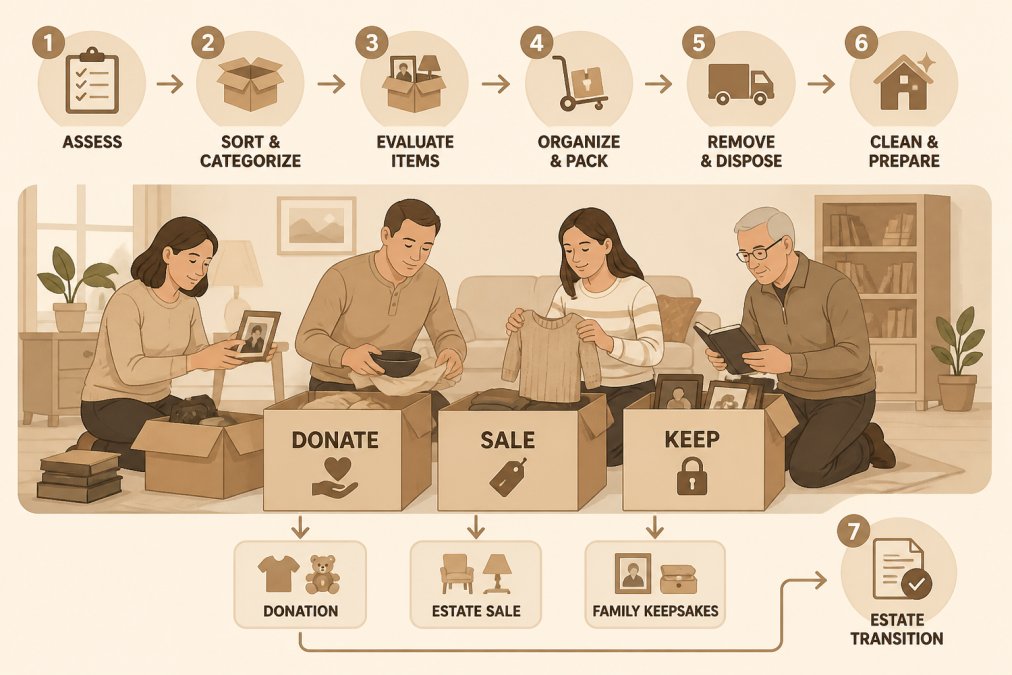
The process typically unfolds in stages. First comes the assessment phase, walking through the home, cataloging items, and determining what has monetary value, what has sentimental worth, and what should be donated or discarded. Many families underestimate how long this takes. A modest three-bedroom house can contain 10,000+ items (peer-reviewed research). Without a system, this becomes paralyzing.
Next is the sorting and staging phase. Items destined for estate sale need to be grouped and photographed. Donations require coordination with nonprofits. Trash removal requires planning. Family heirlooms may need to be inventoried for probate purposes. This is where a move management service becomes invaluable, they handle the logistics, coordinate multiple vendors, and manage the timeline.
The final phase is the actual removal and transition. If the home is being sold, it must be cleared entirely. If a senior is moving to a facility, their belongings need to be sorted into what goes with them and what doesn't. This requires compassionate handling because families are often making these decisions while grieving.
A common mistake is trying to do this alone or delegating it piecemeal to different people. One family member handles the estate sale company, another coordinates donations, a third arranges trash removal. Without a coordinator, communication breaks down, deadlines slip, and family members end up duplicating effort or making conflicting decisions.
This is precisely what estate transition services address. They provide a single point of contact, manage the timeline, and ensure nothing falls through the cracks. Local estate planners can advise on what items have legal relevance (like documents needed for probate), but they typically don't manage the physical decluttering itself.
Senior Move Management Services Explained
Senior move management has emerged as a specialized service category over the past 15 years, distinct from both traditional moving companies and estate transition services (aarp.org). The focus is on the human element: helping seniors (and their families) navigate relocation with dignity and minimal stress (peer-reviewed research).

Senior move management services typically include: downsizing consultation, where advisors help seniors decide what to keep when moving to a smaller space; packing and unpacking services; coordination with the receiving facility (assisted living, nursing home, or new home); and often liaison with family members who may live out of state.
The difference between senior move management and general estate transition services matters. Senior move management assumes the senior is still alive and involved in decisions. Estate transition services assume the senior has passed and the family is managing the process. The emotional dynamics are completely different.
When a senior is moving from a family home to assisted living, they're often grieving the loss of independence and leaving behind decades of memories. A skilled move manager doesn't just pack boxes, they help the senior decide what brings them joy in their new space and what can be released. This requires empathy, patience, and understanding of the psychological aspects of relocation.
Many families hire move managers when a parent has a health crisis and needs to relocate quickly. The alternative, asking adult children to travel home, take time off work, and sort through a lifetime of belongings, is logistically impossible for most families. A professional handles the heavy lifting, both literally and emotionally.
The cost structure for senior move management varies. Some companies charge hourly rates for consultation and planning. Others charge flat fees for complete move packages. Still others work on commission from estate sales or receive referral fees from receiving facilities. Understanding the fee model matters because it affects whether the advisor is incentivized to downsize aggressively or preserve more items.
Understanding the Cost of Professional Estate Transition Services
The question families ask most urgently is simple: "How much will this cost?" The answer is equally simple: it depends. But understanding what drives the cost helps you make smarter decisions about where to invest.
Estate transition services typically charge based on several variables: the size of the home, the volume of items requiring sorting and removal, whether an estate sale is involved, the timeline, and the complexity of family dynamics. A modest home with straightforward decisions might cost less than a large estate where family members disagree about what should happen.
Pricing for move management services and estate transition services are distinct. Move management, helping a senior downsize and relocate, is often priced by the hour or as a flat fee for the entire project. Estate transition services, clearing a home after death and coordinating asset liquidation, may be priced similarly, or they may take a percentage of estate sale proceeds.
This creates an important tension. If a service is paid a percentage of what items sell for, they're incentivized to maximize sale prices. If they're paid a flat fee, they're incentivized to work efficiently and move quickly. If they're paid hourly, they're incentivized to be thorough. Each model has trade-offs.
Many families worry about cost because they're already managing funeral expenses, probate fees, and potential property taxes. The concern is legitimate. However, the alternative, attempting to manage the estate transition yourself or delegating it to unprepared family members, often costs more in hidden ways: time away from work, family conflict, undervalued asset sales, and missed deadlines.
WTS Solutions helps families understand these cost structures and connect with professionals whose pricing aligns with your estate's complexity. Rather than quoting generic figures, we assess your specific situation and help you understand what professional support actually costs in your circumstances.
Key Differences in Service Models and Expertise
The service models of Dovetail Companies and local estate planners diverge sharply in training, expertise, and what they're equipped to handle.
Dovetail Companies operates with a standardized service model designed for scale. Their teams are trained in move management protocols, they have established relationships with estate sale companies and donation centers, and they manage timelines with efficiency. They excel at the operational side: coordinating multiple vendors, managing logistics, and ensuring the home is cleared on schedule. Their expertise is in process, how to move things efficiently and generate value from asset sales.
Local estate planners (typically attorneys or certified financial planners) operate with deep expertise in state-specific legal requirements. They understand probate law, fiduciary duty, beneficiary designations, power of attorney, healthcare directives, and tax implications. Their expertise is in legal strategy, how to structure an estate to minimize tax liability, ensure legal compliance, and protect beneficiaries.
These are not overlapping skill sets. A move management company isn't equipped to advise on whether an estate should be probated or whether a trust structure makes sense. A local estate planner isn't equipped to manage the logistics of clearing a 4,000-square-foot home in two weeks.
Here's where it gets interesting: many families need both services, but they approach them in the wrong order. They hire an estate planner first, who advises on legal structure and tax strategy. Then they discover they still need someone to actually clear the house, coordinate the sale, and manage the move. By then, decisions have been made that affect how efficiently the physical transition can happen.
A better sequence: engage a move management or estate transition service early to assess the scope of the work and timeline. Simultaneously, work with an estate planner on the legal and tax framework. Let the move manager's timeline inform the planner's strategy, and let the planner's decisions inform the move manager's approach.
Making Your Decision: Which Option Fits Your Situation
Choosing between Dovetail Companies and a local estate planner isn't an either-or decision for most families. The real question is: which service do you need first, and how do you coordinate them?
Choose Dovetail Companies or a similar move management service if:
- You need to clear a home quickly (within weeks, not months)
- The estate includes significant belongings requiring sorting, staging, and sale
- Family members live far apart and can't manage logistics in person
- You need coordination across multiple vendors (movers, estate sale companies, donation centers)
- The primary challenge is logistics, not legal complexity
Choose a local estate planner if:
- The estate is complex (multiple properties, significant assets, blended family)
- You need guidance on probate, trust administration, or tax strategy
- There are questions about beneficiary designations or fiduciary duty
- State-specific legal compliance is a concern
- The primary challenge is legal strategy, not logistics
Choose both if:
- You're managing a substantial estate with both legal complexity and significant belongings to clear
- Family members disagree about how to handle the estate (a planner can provide legal clarity; a move manager can handle logistics objectively)
- The timeline is tight and you need professional coordination across multiple areas
- You want to maximize the value of assets while ensuring legal compliance
The decision framework comes down to this: what is your actual bottleneck? Is it understanding the legal requirements and tax implications? Or is it managing the physical and logistical reality of clearing a home, coordinating vendors, and transitioning assets?
Most families discover they have both bottlenecks. The families who navigate estates most smoothly are those who recognize this early and engage appropriate professionals in parallel, with clear communication about timeline and priorities.
WTS Solutions specializes in bridging this gap, connecting families with estate planners for legal guidance while managing the logistics of move management and asset transition. We understand that grief doesn't pause for logistics, and that families need both professional expertise and compassionate coordination.
Conclusion
The choice between Dovetail Companies and local estate planners reflects a deeper truth: estate transition involves both legal complexity and logistical reality. Neither service alone addresses the full scope of what families face after a loss.
WTS Solutions brings compassionate coordination to this intersection. We help families connect with qualified legal professionals for probate and tax guidance while managing the hands-on work of clearing homes, coordinating estate sales, and ensuring smooth transitions. Our partnerships with estate sale companies and move management specialists, combined with our understanding of probate requirements, mean you're not juggling multiple vendors, you have a single point of contact managing the entire process.
If you're facing an estate transition and feeling overwhelmed by the legal, financial, and logistical decisions ahead, connect with WTS Solutions. We'll assess your situation, help you understand what professional support you actually need, and coordinate the right professionals to ease the burden during a difficult time.
Frequently Asked Questions
What is the difference between an estate planning attorney and a transition management firm?
Estate planning attorneys focus on legal documents, wills, trusts, and probate administration. Transition management firms handle the physical logistics: decluttering, moving, asset liquidation, and coordinating between specialists. Many families benefit from both. Attorneys address the legal compliance and fiduciary duty aspects, while transition managers handle the overwhelming day-to-day work of clearing homes and relocating belongings. Your situation determines which you need first.
How much does professional estate transition services typically cost?
Pricing depends on the scope of work, estate size, timeline, and local market factors. Services range from hourly consulting to comprehensive project-based fees. Contact WTS Solutions directly for a detailed quote based on your specific needs. Many families find that professional coordination saves money by maximizing asset sales value and preventing costly mistakes in probate and asset distribution.
Can a local estate planner handle both the legal work and the physical decluttering?
Most traditional estate planners focus on legal documentation and probate administration. They rarely handle the physical work of decluttering, moving, or asset liquidation. That's where senior move management services come in. Some families work with both a local attorney for legal compliance and a transition specialist for logistics. This hybrid approach ensures nothing falls through the cracks.
What should I look for when hiring help for senior relocation and estate management?
Look for experience with probate and estate administration, partnerships with licensed estate sale companies, references from families in your situation, and a compassionate approach to grieving families. Ask about their process for asset protection, how they handle family disagreements, and whether they coordinate with legal professionals. Verify they understand your state's specific regulations and can guide you through the entire transition from start to finish.
This article was written using GrandRanker